 ChipApex | Global Electronic Components Supplier

SEARCH
Search Product
Search Post
— IC芯片 | 连接器 | 传感器 | 被动器件 —
Search productSearch post
— IC芯片 | 连接器 | 传感器 | 被动器件 —
Consult the customer manager about the wholesale price.
consultation hotline:86-132-6715-2157
email:[email protected]
Contact the product manager for consultation. One-stop consultation is available.
Do you want a lower wholesale price? Please send us your inquiry and we will reply immediately.
The MAX22507EAUB+ is a full-duplex RS-485/RS-422 transceiver optimized for high-speed communication up to 50Mbps. It operates on a supply voltage range of 3V to 5.5V with a typical supply current of 4mA and a maximum shutdown current of 5μA. The device features integrated hot-swap protection, fail-safe receivers, and symmetrical receiver thresholds. It supports up to 200 transceivers on the bus and withstands over ±4kV EFT. The component is housed in a 10-pin μMAX package and operates within a temperature range of -40°C to +125°C.
Verify the specific ordering suffix to confirm the package type and RoHS compliance status. The 'U' indicates the 10-pin μMAX package, while '+' denotes lead-free/RoHS compliance. Ensure the procurement channel sources directly from Analog Devices or authorized distributors to guarantee authenticity and traceability for industrial-grade components.
Select this component for applications requiring simultaneous transmission and reception at speeds up to 50Mbps. The low shutdown current makes it suitable for power-sensitive systems. Verify that the system design accommodates the 10-pin μMAX footprint and that the operating environment falls within the specified -40°C to +125°C temperature range.
This part belongs to the MAX22507E/MAX22508E series of high-speed RS-485/RS-422 transceivers. While the MAX22508E offers an 8-pin SOIC package without shutdown capabilities, the MAX22507E provides the additional low-power shutdown feature and utilizes a compact 10-pin μMAX package designed for space-constrained industrial designs.
The MAX22507EAUB+T is the tape-and-reel variant of the same functional device. For pin-compatible alternatives with different packaging, consider the MAX22508E series, though it lacks the shutdown control feature and uses an 8-pin SOIC package instead of the 10-pin μMAX form factor.
The receiver guarantees a logic-high output on RO if the differential input voltage (VA - VB) remains between -50mV and +50mV for longer than 10μs, covering conditions where inputs are open, shorted, or terminated with all drivers disabled.
Hot-swap protection holds the DE input low and RE input high for at least 10μs upon power-up or board insertion. This prevents unintended driver activation caused by voltage transients or leakage currents before the host processor initializes.
Yes, the driver outputs Y and Z can operate in standard differential mode or as individual rail-to-rail single-ended TTL or CMOS logic outputs.
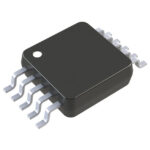 MAX22507EAUB+

The activity of extra discounts on wholesale prices is in full swing…
Please fill in your contact information and we will send you the latest wholesale price list.





