 ChipApex | Global Electronic Components Supplier
SEARCH
Search Product
Search Post
— IC芯片 | 连接器 | 传感器 | 被动器件 —
Search productSearch post
— IC芯片 | 连接器 | 传感器 | 被动器件 —
Consult the customer manager about the wholesale price.
consultation hotline:86-132-6715-2157
email:[email protected]
Contact the product manager for consultation. One-stop consultation is available.
Do you want a lower wholesale price? Please send us your inquiry and we will reply immediately.
The MAX22707AUB+ is a low-power, precision zero-crossing detector manufactured by Analog Devices Inc./Maxim Integrated. It operates on a single supply voltage ranging from 3.0V to 5.5V with a typical quiescent current of 1.0mA and a standby current of 2.0µA. The device provides ±1% accuracy for zero-crossing detection and features selectable fourth-order Low-Pass Filter (LPF) or Band-Pass Filter (BPF) configurations. It supports input frequencies of 50Hz, 60Hz, 100Hz, and 120Hz via the Mode Control pin. The ZCO output is an open-drain type with a maximum output low voltage of 0.4V at 4mA load. The component is housed in a 10-pin µMAX package and functions within an ambient temperature range of -40°C to +125°C.
Verify the specific ordering suffix when sourcing components. The 'T' suffix indicates tape-and-reel packaging, while its absence denotes individual units. Confirm that the '+ ' designation corresponds to lead-free and RoHS-compliant manufacturing standards required for your assembly process. Ensure the selected variant matches the required operating temperature range specifications.
Select the MAX22707AUB+ when high-precision zero-crossing detection is required without external precision filter capacitors. Choose the LPF configuration for applications involving rectified inputs or broader frequency bands, and the BPF configuration for strict 50Hz or 60Hz sinusoidal tracking. Evaluate the input network requirements based on whether the application utilizes single-ended or differential AC line inputs.
This component belongs to the MAX22707 family of precision zero-crossing detectors designed for AC line applications. It replaces complex discrete networks comprising amplifiers, comparators, and passive filters. The device integrates the necessary filtering and detection logic into a compact 10-pin µMAX package, simplifying the bill of materials and reducing the overall circuit board area required for AC sensing tasks.
Public confirmed substitute part numbers are not available in the provided documentation.
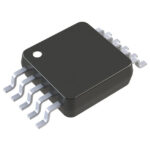 MAX22707AUB+
The activity of extra discounts on wholesale prices is in full swing…
Please fill in your contact information and we will send you the latest wholesale price list.





