 ChipApex | Global Electronic Components Supplier

SEARCH
Search Product
Search Post
— IC芯片 | 连接器 | 传感器 | 被动器件 —
Search productSearch post
— IC芯片 | 连接器 | 传感器 | 被动器件 —
Consult the customer manager about the wholesale price.
consultation hotline:86-132-6715-2157
email:[email protected]
Contact the product manager for consultation. One-stop consultation is available.
Do you want a lower wholesale price? Please send us your inquiry and we will reply immediately.
The MAX243CSE is a dual driver and dual receiver RS-232 transceiver from the MAX220–MAX249 family, designed for EIA/TIA-232E and V.28/V.24 interfaces. It operates on a single +5V supply using an integrated charge pump to generate ±10V internally, eliminating external bipolar supplies. The device supports data rates up to 200 kbps with a typical propagation delay of 3.5 µs for drivers and 1 µs for receivers. It features a 16-pin SOIC-Wide package, operates within a commercial temperature range of 0°C to +70°C, and draws 10 mA during normal operation.
Verify the specific suffix 'CSE' against official documentation to confirm the 16-pin SOIC-Wide package and 0°C to +70°C operating temperature range. Confirm RoHS compliance status through manufacturer declarations. Ensure the component matches the exact pinout and electrical specifications required by the design.
Select this part for applications requiring two independent RS-232 channels powered by a single +5V rail. Verify that the 200 kbps data rate meets system requirements. Consider the 16-pin SOIC-Wide package dimensions for PCB layout constraints. Check if the lack of shutdown control pins aligns with power management needs.
The MAX243 belongs to the MAX220–MAX249 family of +5V-powered multichannel RS-232 drivers and receivers. This series provides various channel configurations and package options to accommodate different interface density and space requirements while maintaining compatibility with standard RS-232 protocols.
Public confirmed substitute part numbers: None identified in verified source material.
Unlike other devices in the family, the MAX243 R2IN has a negative input threshold range (-3V to -0.1V) for logic-high detection, ensuring the output remains low when the input is unconnected or at positive voltages.
No, the MAX243 does not include a shutdown (SHDN) pin or low-power mode functionality; it operates continuously once powered.
It uses internal dual charge-pump DC-DC converters to step up the +5V supply to approximately +10V and invert it to -10V, driving the RS-232 outputs without external capacitors for voltage generation.
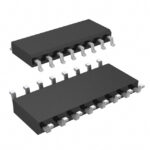 MAX243CSE

The activity of extra discounts on wholesale prices is in full swing…
Please fill in your contact information and we will send you the latest wholesale price list.






