 ChipApex | Global Electronic Components Supplier
SEARCH
Search Product
Search Post
— IC芯片 | 连接器 | 传感器 | 被动器件 —
Search productSearch post
— IC芯片 | 连接器 | 传感器 | 被动器件 —
Consult the customer manager about the wholesale price.
consultation hotline:86-132-6715-2157
email:[email protected]
Contact the product manager for consultation. One-stop consultation is available.
Do you want a lower wholesale price? Please send us your inquiry and we will reply immediately.
The MAX265BEWI+ is a universal switched-capacitor filter IC from Analog Devices Inc./Maxim Integrated, housed in a 28-SOIC package. It provides a second-order filtering response with a center frequency of 57kHz. The device operates on a supply voltage range of 4.74V to 12.6V or ±2.37V to ±6.3V. Designed for precision signal processing, it integrates clock generation and requires minimal external components, making it suitable for applications demanding accurate analog filtering within mixed-signal systems.
Verify component authenticity through authorized distributors due to potential counterfeit risks. Confirm RoHS compliance status via official documentation before integration. Ensure supply chain stability as availability may fluctuate. Validate pinout compatibility with existing PCB layouts during replacement planning. Review latest datasheet revisions for any functional updates or packaging changes prior to procurement.
Select this component when a compact, low-component-count solution for second-order filtering is required. Consider the 57kHz center frequency suitability for the target signal bandwidth. Evaluate power supply constraints against the specified 4.74V to 12.6V operating range. Assess thermal performance within the SOIC package for the expected power dissipation. Verify interface requirements do not necessitate additional clock circuitry.
This part belongs to the MAX265 series of universal switched-capacitor filters by Maxim Integrated, now part of Analog Devices. These ICs are designed to replace traditional active RC filters, offering improved accuracy and reduced size. The series typically includes variants with different cutoff frequencies, allowing designers to tailor filtering characteristics without changing the fundamental circuit topology or component count significantly.
Direct substitutes include other MAX265 series variants such as MAX265BCPI+ or MAX266BEWI+, which offer similar functionality but potentially different cutoff frequencies or package options. When replacing, ensure the new part's center frequency matches the application requirements. Verify that the pinout remains compatible if swapping between specific suffixes. Check for any differences in supply voltage ranges or power consumption specifications.
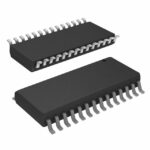 MAX265BEWI+
The activity of extra discounts on wholesale prices is in full swing…
Please fill in your contact information and we will send you the latest wholesale price list.





