 ChipApex | Global Electronic Components Supplier
SEARCH
Search Product
Search Post
— IC芯片 | 连接器 | 传感器 | 被动器件 —
Search productSearch post
— IC芯片 | 连接器 | 传感器 | 被动器件 —
Consult the customer manager about the wholesale price.
consultation hotline:86-132-6715-2157
email:[email protected]
Contact the product manager for consultation. One-stop consultation is available.
Do you want a lower wholesale price? Please send us your inquiry and we will reply immediately.
The MAX268BCWG+ is a pin-programmable universal and bandpass active filter manufactured by Analog Devices Inc./Maxim Integrated. It operates within a supply voltage range of 4.74V to 12.6V, or ±2.37V to ±6.3V. The device features two second-order filter sections housed in a 24-SOIC package with a width of 0.295 inches (7.50mm). It supports a center frequency or cutoff frequency of 140kHz. The component is designed for surface-mount installation and functions reliably across an operating temperature range from 0°C to +70°C.
Verify the specific suffix 'CWG+' against the manufacturer's current datasheet to confirm package type and temperature grade. Confirm RoHS compliance status as indicated in the latest documentation. Check for end-of-life notifications or discontinuance alerts prior to finalizing procurement plans.
Select this component when dual second-order switched-capacitor filtering is required with digital programmability. Ensure the application environment stays within the specified 0°C to +70°C temperature range. Verify that the available clock input matches the desired center frequency of 140kHz.
This part belongs to the MAX263/MAX264/MAX267/MAX268 family of pin-programmable universal and bandwidth filters. These devices share common architectural features such as CMOS technology and switched-capacitor operation, differing primarily in performance specifications like maximum center frequency and package options.
Consider the MAX268ACWG+ for similar functionality with potentially different commercial/industrial temperature ratings. Verify pin compatibility and electrical specifications against the original design requirements before substitution.
The center frequency is determined by the input clock signal and the 6-bit f0 program input, allowing precise tuning without affecting other filter parameters.
Yes, the device is a switched-capacitor filter that does not require external capacitors or resistors for configuring bandpass, lowpass, highpass, notch, or allpass functions.
The filter Q is programmed independently through the device's pin-programmable interface, separate from the frequency setting controls.
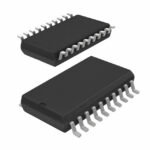 MAX268BCWG+
The activity of extra discounts on wholesale prices is in full swing…
Please fill in your contact information and we will send you the latest wholesale price list.





