 ChipApex | Global Electronic Components Supplier
SEARCH
Search Product
Search Post
— IC芯片 | 连接器 | 传感器 | 被动器件 —
Search productSearch post
— IC芯片 | 连接器 | 传感器 | 被动器件 —
Consult the customer manager about the wholesale price.
consultation hotline:86-132-6715-2157
email:[email protected]
Contact the product manager for consultation. One-stop consultation is available.
Do you want a lower wholesale price? Please send us your inquiry and we will reply immediately.
The MAX271EWG+ is a digitally-programmed, dual second-order continuous-time lowpass filter in a 20-pin Wide SO package. It operates within a supply voltage range of ±2.375V to ±8V and supports cutoff frequencies from 1kHz to 25kHz via 7-bit digital control. The device features two independent filter sections with a typical dynamic range of 96dB and includes an integrated track-and-hold circuit. It offers a low-power shutdown mode consuming less than 15µA and is rated for operation between -40°C and +85°C.
Verify the component authenticity by checking the manufacturer markings against official datasheet specifications. Confirm the package type matches the required footprint and ensure the temperature grade aligns with system operational requirements. Cross-reference the ordering suffix to confirm lead-free compliance status as documented by the manufacturer.
Select this component when a dual-channel continuous-time filter with integrated sampling is required. Ensure the application supports the specified bipolar or unipolar supply voltages. Verify that the digital interface logic levels are compatible with the system microcontroller or control circuitry for proper frequency programming.
This part belongs to the MAX270/MAX271 family of analog filters. The MAX271 variant specifically integrates a track-and-hold function, distinguishing it from the MAX270 which provides an uncommitted operational amplifier instead. Both share identical filter core characteristics and digital programming interfaces.
The MAX270EWG+ serves as a functional substitute if the track-and-hold feature is not required, offering an uncommitted op amp instead. Other variants within the MAX270/MAX271 series may be considered based on specific temperature ranges or package configurations.
The cutoff frequency is set by applying a 7-bit digital code (D0-D6) to the data pins. This code selects one of 128 predefined frequencies ranging from 1kHz to 25kHz.
The MODE pin selects the operating mode. Connecting it to GND or V- enables microprocessor control mode, while connecting it to V+ enables pin-strap mode for direct hardware configuration without timing requirements.
Yes, the two filter sections can be cascaded to achieve higher-order roll-off characteristics, such as a 4th-order response with approximately 80dB/decade attenuation.
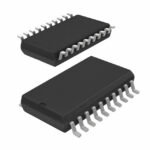 MAX271EWG+
The activity of extra discounts on wholesale prices is in full swing…
Please fill in your contact information and we will send you the latest wholesale price list.





