 ChipApex | Global Electronic Components Supplier
SEARCH
Search Product
Search Post
— IC芯片 | 连接器 | 传感器 | 被动器件 —
Search productSearch post
— IC芯片 | 连接器 | 传感器 | 被动器件 —
Consult the customer manager about the wholesale price.
consultation hotline:86-132-6715-2157
email:[email protected]
Contact the product manager for consultation. One-stop consultation is available.
Do you want a lower wholesale price? Please send us your inquiry and we will reply immediately.
The MAX3084EESA+T is a full-duplex RS-422/RS-485 transceiver manufactured by Analog Devices Inc./Maxim Integrated. It contains one driver and one receiver, supporting data rates up to 500kbps with slew-rate limiting enabled via the SRL pin. The device operates on a single +5V supply (4.75V to 5.25V) and draws 375µA typical quiescent current. It features ±15kV ESD protection on all I/O pins and fail-safe circuitry that guarantees a logic-high receiver output when inputs are open or shorted. Packaged in an 8-pin SOIC, it supports operation from -40°C to +85°C.
Verify the specific suffix 'T' indicates tape-and-reel packaging versus tube packaging for the base part number. Confirm the 'E' designation corresponds to the industrial temperature range of -40°C to +85°C. Ensure the component source matches the official manufacturer specifications for the MAX3084 series.
Select this component for full-duplex applications requiring data transmission speeds up to 500kbps. It is suitable for environments where reduced electromagnetic emissions are critical due to its internal slew-rate limiting. Ensure the system design accommodates the standard 8-pin SOIC footprint and +5V power requirements.
This device belongs to the MAX3080E–MAX3089E family of high-speed transceivers. While sharing the same package and core functionality, variants within this series differ primarily in duplex mode support and maximum achievable data rates based on their specific slew-rate configurations.
The datasheet notes pin compatibility with industry-standard parts like the 75180. Verify functional equivalence regarding the specific 500kbps slew-rate limit and full-duplex architecture before substitution.
The MAX3084E achieves a maximum data rate of 500kbps by utilizing internally limited driver slew rates, which are optimized for this speed class compared to the 115kbps or 10Mbps variants in the same family.
The integrated fail-safe circuitry guarantees that the receiver output will remain in a logic-high state if the differential inputs (A and B) are open, shorted, or connected to a terminated line with no active drivers.
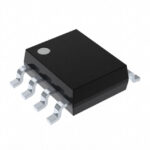 MAX3084EESA+T
The activity of extra discounts on wholesale prices is in full swing…
Please fill in your contact information and we will send you the latest wholesale price list.





