 ChipApex | Global Electronic Components Supplier
SEARCH
Search Product
Search Post
— IC芯片 | 连接器 | 传感器 | 被动器件 —
Search productSearch post
— IC芯片 | 连接器 | 传感器 | 被动器件 —
Consult the customer manager about the wholesale price.
consultation hotline:86-132-6715-2157
email:[email protected]
Contact the product manager for consultation. One-stop consultation is available.
Do you want a lower wholesale price? Please send us your inquiry and we will reply immediately.
The MAX3089CPD+ is a high-speed RS-485/RS-422 transceiver housed in a 14-pin Plastic DIP package. It operates on a single +5V supply (4.75V to 5.25V) and features selectable half-duplex or full-duplex modes via the H/F pin. The device supports three data rates—115kbps, 500kbps, and 10Mbps—controlled by the SRL pin. It includes fail-safe circuitry ensuring a logic-high receiver output when inputs are open or shorted. Quiescent current is typically 375µA, with shutdown current at 10nA maximum. Operating temperature range is 0°C to +70°C.
Verify the specific suffix 'CPD+' corresponds to the 14-pin Plastic DIP package and the commercial temperature range of 0°C to +70°C. Confirm that the component is sourced from Analog Devices or Maxim Integrated to ensure authenticity. Check datasheet revisions for any updates regarding electrical characteristics or pin configurations before finalizing procurement orders.
Select this component when flexible configuration of duplex mode and data transmission speed is required within a single package. It is suitable for systems needing independent control over transmitter and receiver signal phases. Ensure the application environment remains within the specified 0°C to +70°C operating temperature range and utilizes a standard +5V power supply.
This part belongs to the MAX3080–MAX3089 family of high-speed transceivers designed for RS-485 and RS-422 standards. Unlike fixed-function variants in the series, the MAX3089 offers programmable operational modes. It shares the same 1/8-unit-load receiver impedance as other family members, supporting extensive bus topologies.
The MAX3089CSD+ serves as a surface-mount alternative with identical electrical specifications but utilizes a 14-SOIC package. Other family members like the MAX3086 offer fixed 10Mbps performance without the configurability of the MAX3089.
The data rate is determined by the state of the SRL pin. Connecting it to VCC selects 500kbps, connecting it to GND selects 10Mbps, and leaving it unconnected selects 115kbps.
The fail-safe circuitry ensures that the receiver output (RO) goes to a logic-high state if the differential input voltage is greater than -50mV, which occurs when inputs are open or shorted.
Yes, the TXP pin controls the transmitter phase and the RXP pin controls the receiver phase. Driving these pins high inverts their respective signal polarities.
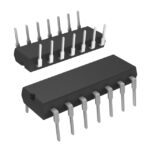 MAX3089CPD+
The activity of extra discounts on wholesale prices is in full swing…
Please fill in your contact information and we will send you the latest wholesale price list.






