 ChipApex | Global Electronic Components Supplier
SEARCH
Search Product
Search Post
— IC芯片 | 连接器 | 传感器 | 被动器件 —
Search productSearch post
— IC芯片 | 连接器 | 传感器 | 被动器件 —
Consult the customer manager about the wholesale price.
consultation hotline:86-132-6715-2157
email:[email protected]
Contact the product manager for consultation. One-stop consultation is available.
Do you want a lower wholesale price? Please send us your inquiry and we will reply immediately.
The MAX3089ECPD+ is a ±15kV ESD-protected, fail-safe, high-speed RS-485/RS-422 transceiver in a 14-pin Plastic DIP package. It operates from a single +5V supply (4.75V to 5.25V) and features one driver and one receiver. The device supports selectable data rates of 115kbps, 500kbps, and 10Mbps via the SRL pin. It allows configurable half-duplex or full-duplex operation through the H/F pin and includes independent phase control for transmitter (TXP) and receiver (RXP). Typical quiescent current is 375µA, with shutdown current at 1nA.
Verify the specific suffix 'CPD+' corresponds to the 0°C to +70°C temperature range and 14-pin Plastic DIP package configuration. Confirm that the ordering information matches the manufacturer's latest datasheet revision to ensure compatibility with required slew-rate and duplex settings.
Select this component when design requirements demand a single IC capable of switching between half-duplex and full-duplex modes without changing part numbers. It is suitable for systems needing adjustable transmission speeds to balance between EMI reduction and high-speed data throughput.
This device belongs to the MAX3080E–MAX3089E family of high-speed transceivers. While other members of the series have fixed data rates or duplex modes, the MAX3089E provides unique flexibility by allowing users to program these parameters via external pins, bridging the gap between specialized fixed-function parts.
The MAX3089E is pin-compatible with the standard 75180 transceiver. Designers replacing a 75180 should account for the additional programming pins (SRL, H/F, TXP, RXP) which must be properly terminated or driven to achieve desired performance characteristics.
The data rate is determined by the state of the SRL pin: leave it unconnected for 115kbps, connect to VCC for 500kbps, or connect to GND for 10Mbps.
Yes, the mode is selected via the H/F pin; connecting it to GND enables full-duplex, while driving it high enables half-duplex.
These pins allow independent phase inversion for the transmitter and receiver outputs, which corrects signal polarity if twisted-pair cables are connected backward.
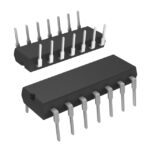 MAX3089ECPD+
The activity of extra discounts on wholesale prices is in full swing…
Please fill in your contact information and we will send you the latest wholesale price list.





