 ChipApex | Global Electronic Components Supplier
SEARCH
Search Product
Search Post
— IC芯片 | 连接器 | 传感器 | 被动器件 —
Search productSearch post
— IC芯片 | 连接器 | 传感器 | 被动器件 —
Consult the customer manager about the wholesale price.
consultation hotline:86-132-6715-2157
email:[email protected]
Contact the product manager for consultation. One-stop consultation is available.
Do you want a lower wholesale price? Please send us your inquiry and we will reply immediately.
The MAX3089EESD+ is a ±15kV ESD-protected, fail-safe RS-485/RS-422 transceiver in a 14-pin SOIC package. It operates on a single +5V supply (4.75V to 5.25V) with a typical quiescent current of 375µA and a shutdown current of 1nA. The device features one driver and one receiver with selectable half/full-duplex operation via the H/F pin. Slew rates are programmable between 115kbps, 500kbps, and 10Mbps using the SRL pin. Phase inversion for twisted-pair reversal is supported via TXP and RXP pins.
Verify the specific suffix 'ESD+' indicates the standard SOIC-14 surface-mount package variant. Confirm that the ordering information matches the exact temperature range (-40°C to +85°C) required for the application environment before finalizing procurement.
Select this component when flexible data rate configuration and duplex mode switching are required within a single package. Ensure the design accommodates the three-state driver requirements for the SRL, H/F, TXP, and RXP programming pins to utilize the device's full feature set effectively.
This part belongs to the MAX3080E–MAX3089E family of high-speed transceivers. Unlike fixed-function variants, the MAX3089E provides unique configurability through dedicated selector pins, allowing it to adapt to varying bus speed and topology requirements without changing the physical hardware layout.
The datasheet notes pin compatibility with the industry-standard 75180 transceiver. However, the MAX3089E includes additional programmable features not present in the 75180. Verify that any replacement maintains the required 14-pin SOIC footprint and voltage specifications.
The data rate is selected by driving the SRL pin: connect to VCC for 500kbps, GND for 10Mbps, or leave unconnected for 115kbps.
The H/F pin selects the communication mode; connecting it to VCC enables half-duplex, while connecting it to GND or leaving it unconnected enables full-duplex.
It uses the TXP and RXP pins to independently invert the transmitter and receiver phases, correcting signal polarity if the cable is connected backward.
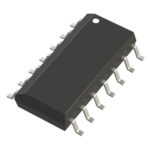 MAX3089EESD+
The activity of extra discounts on wholesale prices is in full swing…
Please fill in your contact information and we will send you the latest wholesale price list.





