 ChipApex | Global Electronic Components Supplier
SEARCH
Search Product
Search Post
— IC芯片 | 连接器 | 传感器 | 被动器件 —
Search productSearch post
— IC芯片 | 连接器 | 传感器 | 被动器件 —
Consult the customer manager about the wholesale price.
consultation hotline:86-132-6715-2157
email:[email protected]
Contact the product manager for consultation. One-stop consultation is available.
Do you want a lower wholesale price? Please send us your inquiry and we will reply immediately.
The MAX3098EAEEE+T is a triple RS-422/RS-485 receiver featuring integrated fault-detection circuitry and dedicated fault-status outputs. It operates from a single +3V to +5.5V supply with a typical supply current of 4mA. The device supports data rates up to 32Mbps and provides ±15kV ESD protection on all inputs. It detects open-circuit, short-circuit, low differential voltage, and common-mode range violations. The part is housed in a 16-pin QSOP package and functions within an operating temperature range of -40°C to +85°C.
Verify the specific suffix EAEEE against official documentation to confirm the 16-pin QSOP package, -40°C to +85°C temperature range, and A-grade fault thresholds. Confirm RoHS compliance status and lead-free manufacturing details directly with Analog Devices or authorized distributors before procurement.
Select this component when designing motor control loops that require simultaneous monitoring of three differential channels (A, B, Z). Choose the MAX3098E over the MAX3097E if the application demands tighter differential fault thresholds (±200mV) rather than wider margins. Ensure the system can accommodate the 16-pin QSOP footprint and provide external capacitance for the programmable delay feature.
This device belongs to the MAX3097E/MAX3098E family of rugged, low-power receivers designed for harsh industrial environments. It serves as a specialized interface for absolute positioning control loops, offering enhanced reliability compared to standard RS-485 receivers by actively reporting line faults to the host processor.
The MAX3097EAEEE+T is the primary functional substitute within the same family, differing only in fault-detection threshold specifications. Verify compatibility regarding the specific differential voltage limits required by the encoder interface.
The delay time for the ALARMD output is set by connecting a capacitor between the DELAY pin and GND. The duration depends on the supply voltage and the capacitance value, following the equation tD = 15 + 0.33 x CDELAY for VCC = 5V.
Individual alarm outputs go high when the receiver input is in an open-circuit condition, short-circuit condition, outside the common-mode range, or when the differential input voltage falls below the preset fault threshold.
No, the MAX3098E is a receiver-only device. It does not contain drivers, so it cannot transmit data and is used solely for receiving RS-422/RS-485 signals.
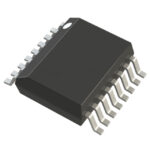 MAX3098EAEEE+T
The activity of extra discounts on wholesale prices is in full swing…
Please fill in your contact information and we will send you the latest wholesale price list.





