 ChipApex | Global Electronic Components Supplier
SEARCH
Search Product
Search Post
— IC芯片 | 连接器 | 传感器 | 被动器件 —
Search productSearch post
— IC芯片 | 连接器 | 传感器 | 被动器件 —
Consult the customer manager about the wholesale price.
consultation hotline:86-132-6715-2157
email:[email protected]
Contact the product manager for consultation. One-stop consultation is available.
Do you want a lower wholesale price? Please send us your inquiry and we will reply immediately.
The MAX3098EAEPE is a triple RS-422/RS-485 receiver manufactured by Analog Devices Inc./Maxim Integrated. It operates on a single +3V to +5.5V supply and supports data rates up to 32Mbps. The device features fault-detection circuitry with independent alarm outputs for each receiver channel, identifying open-circuit, short-circuit, low differential voltage, and common-mode range violations. It includes a capacitor-programmable delayed fault output (ALARMD) to prevent erroneous alarms at slow edge rates. ESD protection is rated at ±15kV (Human Body Model) and ±15kV (IEC Air-Gap). The component is housed in a 16-pin Plastic DIP package and functions within an operating temperature range of -40°C to +85°C.
Verify the specific ordering suffix against official documentation to confirm the exact package type and temperature range. Confirm that the 'P' suffix corresponds to the 16-pin Plastic DIP package as specified in the manufacturer's ordering information. Ensure compatibility with system requirements for the -40°C to +85°C industrial temperature grade before procurement.
Select this component when triple-channel reception with comprehensive fault monitoring is required. It is suitable for applications needing robust signal integrity verification in noisy environments. Consider the 16-pin Plastic DIP package if through-hole mounting is necessary. Verify that the 32Mbps maximum data rate meets the system's communication speed requirements.
This part belongs to the MAX3097E/MAX3098E family of high-speed receivers. The MAX3098 variant specifically provides three receiver channels, whereas the MAX3097 offers different configurations. The 'E' suffix indicates the industrial temperature range (-40°C to +85°C), and the 'P' suffix denotes the 16-pin Plastic DIP package format.
Direct pin-compatible replacements within the same family include MAX3098EBEPE (different fault thresholds) or MAX3098EAESE (SO package). Cross-family alternatives like the MAX3095 series offer quad receivers but lack the specific fault detection features of the MAX3098.
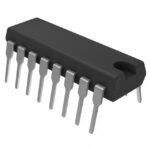 MAX3098EAEPE
The activity of extra discounts on wholesale prices is in full swing…
Please fill in your contact information and we will send you the latest wholesale price list.







