 ChipApex | Global Electronic Components Supplier
SEARCH
Search Product
Search Post
— IC芯片 | 连接器 | 传感器 | 被动器件 —
Search productSearch post
— IC芯片 | 连接器 | 传感器 | 被动器件 —
Consult the customer manager about the wholesale price.
consultation hotline:86-132-6715-2157
email:[email protected]
Contact the product manager for consultation. One-stop consultation is available.
Do you want a lower wholesale price? Please send us your inquiry and we will reply immediately.
The MAX3157CAI is a high CMRR RS-485/RS-422 data-communications interface providing ±50V isolation in a hybrid microcircuit. It contains one transmitter and one receiver, operating at data rates up to 250kbps with a single +5V supply. The device features fail-safe circuitry guaranteeing a logic-high output when inputs are open or shorted. Supply current typically draws 25mA when active and drops to 25µA in shutdown mode. It operates within a temperature range of 0°C to +70°C and is housed in a 28-pin SSOP package.
Verify the specific ordering suffix CAI confirms the commercial temperature range (0°C to +70°C) and the 28-pin SSOP package type. Confirm that the component is sourced from authorized distributors to ensure authenticity, as this is an older generation isolated transceiver. Check datasheet revisions for any updates regarding absolute maximum ratings or application capacitor values before finalizing procurement.
Select the MAX3157CAI when ±50V isolation is required for RS-485 or RS-422 networks without using optocouplers. Ensure the system operates on a single +5V supply and requires low-power shutdown capabilities. Verify that the 250kbps data rate meets network requirements. Consider the EAI variant if operation below 0°C is necessary, or the CPI/PDI variants if through-hole mounting is preferred over surface mount.
The MAX3157 series serves as a low-cost replacement for traditional opto-isolated transceivers in industrial communication systems. The CAI suffix specifically denotes the commercial grade version packaged in a compact 28-pin SSOP format. This part belongs to a family designed to simplify isolated interface design by integrating charge-pump functionality directly into the hybrid microcircuit.
Public confirmed substitute part numbers: MAX3157EAI, MAX3157CPI, MAX3157EPI.
It uses a hybrid microcircuit with external ±50V capacitors connected to C1HI/C1LO and C2HI/C2LO pins to transfer power from the logic side to the isolated side via a charge pump.
The H/F pin selects the mode; connecting it to ISOCOM enables full-duplex, while connecting it to ISOVCC enables half-duplex.
The receiver guarantees a logic-high output if the differential input voltage (A-B) is greater than -50mV, ensuring a safe state when inputs are open, shorted, or terminated with drivers disabled.
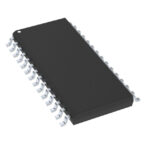 MAX3157CAI
The activity of extra discounts on wholesale prices is in full swing…
Please fill in your contact information and we will send you the latest wholesale price list.





