 ChipApex | Global Electronic Components Supplier
SEARCH
Search Product
Search Post
— IC芯片 | 连接器 | 传感器 | 被动器件 —
Search productSearch post
— IC芯片 | 连接器 | 传感器 | 被动器件 —
Consult the customer manager about the wholesale price.
consultation hotline:86-132-6715-2157
email:[email protected]
Contact the product manager for consultation. One-stop consultation is available.
Do you want a lower wholesale price? Please send us your inquiry and we will reply immediately.
The MAX3160EEAP+T is a multiprotocol transceiver manufactured by Analog Devices Inc./Maxim Integrated, housed in a 20-pin SSOP package. It supports RS-232, RS-485, and RS-422 interfaces with a supply voltage range of +3.0V to +5.5V. The device features ±15kV ESD protection on all transmitter outputs and receiver inputs. It operates within an extended temperature range of -40°C to +85°C. Key electrical parameters include a maximum data rate of 250kbps in slew-rate limited mode, up to 1Mbps for RS-232 and 10Mbps for RS-485/RS-422 when slew-rate limiting is disabled. Shutdown current is typically 1µA.
Verify the component authenticity by checking the manufacturer marking against official datasheet specifications. Confirm the package type matches the required SSOP-20 footprint and ensure the temperature grade corresponds to the 'E' suffix for extended industrial ranges. Cross-reference the ordering information table to validate the specific part number variant before finalizing procurement.
Select this component when designing systems requiring flexible protocol conversion between RS-232 and RS-485/RS-422 standards. The flow-through pinout facilitates efficient board layout for space-constrained designs. Ensure the application environment requires the specified extended temperature range and that the single-supply architecture aligns with the system's power distribution constraints.
This device belongs to the MAX3160E/MAX3161E/MAX3162E family of multiprotocol transceivers. While the MAX3160E shares I/O ports between protocols, other family members like the MAX3161E and MAX3162E offer separate I/O configurations for simultaneous multi-protocol operations. This specific part represents the standard 20-pin SSOP implementation optimized for multiprotocol bus applications.
Direct functional substitutes within the same family include the MAX3161EAP+ and MAX3162EAI+. Note that these alternatives utilize different pin counts (24-pin and 28-pin SSOP respectively) and distinct pinout configurations, necessitating careful review of schematic compatibility and PCB layout adjustments.
The FAST input controls the transmitter slew rate. When asserted, it disables slew-rate limiting, allowing higher data rates up to 10Mbps for RS-485/RS-422 and 1Mbps for RS-232. When unasserted, slew-rate limiting is active to reduce EMI at lower speeds.
The SHDN pin is an active-low shutdown control input. Driving it low shuts down the charge pump and transmitters, reducing the supply current to approximately 1µA while keeping RS-232 receivers active if applicable.
No, the device incorporates an internal dual charge pump that requires external flying capacitors (C1-C4) and a bypass capacitor (CBYPASS) to generate the necessary negative and positive voltages for RS-232 compliance.
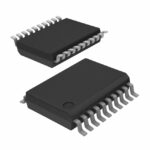 MAX3160EEAP+
The activity of extra discounts on wholesale prices is in full swing…
Please fill in your contact information and we will send you the latest wholesale price list.





