 ChipApex | Global Electronic Components Supplier
SEARCH
Search Product
Search Post
— IC芯片 | 连接器 | 传感器 | 被动器件 —
Search productSearch post
— IC芯片 | 连接器 | 传感器 | 被动器件 —
Consult the customer manager about the wholesale price.
consultation hotline:86-132-6715-2157
email:[email protected]
Contact the product manager for consultation. One-stop consultation is available.
Do you want a lower wholesale price? Please send us your inquiry and we will reply immediately.
The MAX3172EAI+ is a +3.3V multiprotocol cable terminator and transceiver in a 28-pin SSOP package, operating from -40°C to +85°C. It integrates five software-selectable termination networks supporting V.11 (100Ω differential), V.35 (T-network), and V.28/V.10 (high-Z). The device includes a 1Tx/1Rx transceiver for handshake signals, selectable between V.10 and V.28 modes. Electrical characteristics include a supply current of 200µA typical, data rates up to 240kbps, and receiver glitch rejection of 10µs. Logic inputs are compatible with 3V/5V systems.
Verify the component status as discontinued or end-of-life through official manufacturer channels before design finalization. Confirm that the E suffix corresponds to the industrial temperature range (-40°C to +85°C) required for the application environment. Ensure compatibility with the MAX3170/MAX3171 chipset if a complete interface solution is needed.
Select the MAX3172EAI+ over the MAX3174 variant when receiver input deglitching is necessary for unterminated operation at lower frequencies. Verify that the system requires a single-chip solution combining termination logic and handshake transceivers. Ensure the design supports the required V+ and V- supply levels generated by an external charge pump.
This component belongs to the MAX317x family of +3.3V multiprotocol interfaces. It functions alongside the MAX3170 (clock/data transceiver) and MAX3171/MAX3173 (control transceiver/charge pump) to form a complete DTE/DCE port. The EAI+ suffix indicates the extended temperature range and lead-free packaging.
Public confirmed substitute part numbers: None identified.
The 10µs deglitching on the MAX3172 allows for glitch-free operation in unterminated systems by blocking high-frequency noise with bit periods less than 5µs while passing low-frequency signals greater than 15µs.
When all mode-select inputs (M0, M1, M2) are HIGH, the device enters no-cable mode, disabling driver/receiver bias circuitry and dropping supply current below 200µA while placing termination networks in V.11 mode.
In V.11 mode, the termination networks present a typical differential-mode impedance of 104Ω (range 100Ω to 110Ω) to terminate RS-422, RS-530, and related protocols.
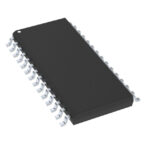 MAX3172EAI+
The activity of extra discounts on wholesale prices is in full swing…
Please fill in your contact information and we will send you the latest wholesale price list.





