 ChipApex | Global Electronic Components Supplier
SEARCH
Search Product
Search Post
— IC芯片 | 连接器 | 传感器 | 被动器件 —
Search productSearch post
— IC芯片 | 连接器 | 传感器 | 被动器件 —
Consult the customer manager about the wholesale price.
consultation hotline:86-132-6715-2157
email:[email protected]
Contact the product manager for consultation. One-stop consultation is available.
Do you want a lower wholesale price? Please send us your inquiry and we will reply immediately.
The MAX3174CAI+ is a +3.3V multiprotocol cable terminator and transceiver housed in a 28-pin SSOP package. It integrates five software-selectable termination networks supporting V.11 (RS-422/530), V.35, and V.28/V.10 protocols. The device includes a single transmitter and receiver for handshake signals, operating at data rates up to 240kbps. It requires external V+ and V- supplies generated by companion charge pumps. Operating temperature range is 0°C to +70°C.
Verify the component status as obsolete or end-of-life through official manufacturer channels before finalizing design-in decisions. Confirm that the specific ordering suffix corresponds to the required RoHS compliance level and packaging format. Ensure compatibility with existing supply chain sources for legacy components.
Select this component when a software-configurable solution for multiprotocol serial interfaces is required without using mechanical relays. It is specifically intended for use alongside the MAX3170 clock/data transceiver and MAX3171/MAX3173 control transceivers. Verify that the application does not require the 10µs receiver input deglitching feature, which is exclusive to the MAX3172 variant.
This device belongs to the MAX317x family of +3.3V multiprotocol interface solutions. It functions as a complementary component to the MAX3170 and MAX3171/MAX3173 chips to form a complete serial port interface. The MAX3174 differs from the MAX3172 primarily by the absence of receiver glitch rejection circuitry, allowing for higher frequency operation on handshake lines.
Public confirmed substitute part numbers include MAX3172CAI+.
No, the MAX3174 does not feature receiver input deglitching. This functionality is available only in the MAX3172 variant.
The V+ and V- pins must be supplied by an external charge pump, typically provided by the MAX3171 or MAX3173, generating levels between approximately +4.2V to +6.5V and -3.8V to -6.5V depending on the protocol mode.
In V.35 mode, all five termination networks are configured to provide a 100Ω differential impedance and a 150Ω common-mode impedance using an internal T-network structure.
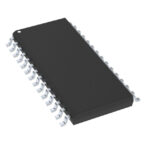 MAX3174CAI+
The activity of extra discounts on wholesale prices is in full swing…
Please fill in your contact information and we will send you the latest wholesale price list.





