 ChipApex | Global Electronic Components Supplier

SEARCH
Search Product
Search Post
— IC芯片 | 连接器 | 传感器 | 被动器件 —
Search productSearch post
— IC芯片 | 连接器 | 传感器 | 被动器件 —
Consult the customer manager about the wholesale price.
consultation hotline:86-132-6715-2157
email:[email protected]
Contact the product manager for consultation. One-stop consultation is available.
Do you want a lower wholesale price? Please send us your inquiry and we will reply immediately.
The MAX31760AEE+ is a digital temperature sensor manufactured by Analog Devices Inc./Maxim Integrated. It features local and remote sensing capabilities with an I2C/SMBus interface. The device operates within a supply voltage range of 3V to 3.6V and provides 11-bit resolution. It supports single-trigger mode, output switching, programmable limits, shutdown, and standby modes. Accuracy is specified at ±1°C (±2°C) under test conditions. Operating temperatures range from -40°C to 125°C for the local sensor and -64°C to 150°C for the remote sensor. It is housed in a 12-TDFN package.
Verify the specific suffix 'AEE' against official manufacturer documentation to confirm pinout, package dimensions, and electrical characteristics match design requirements. Confirm RoHS compliance status through current datasheets. Check for obsolescence notices or lifecycle changes directly from Analog Devices. Ensure ESD handling procedures are followed during assembly due to sensitive CMOS input structures.
Select this component when precise dual-zone monitoring is required alongside low power consumption. Compare against similar MAX317xx series devices for package compatibility and interface needs. Verify that the 11-bit resolution meets system accuracy requirements. Consider the operating temperature range suitability for the intended environment. Evaluate board space constraints against the 12-TDFN footprint.
This part belongs to the MAX31730 family of digital temperature sensors. These devices integrate high-accuracy analog-to-digital converters and signal processing logic. They are designed for applications requiring reliable thermal monitoring without complex external circuitry. The family typically offers various package options and interface configurations to suit different system architectures.
Consult official substitution guides for compatible alternatives within the MAX317xx series. Verify functional equivalence regarding interface protocol and accuracy specifications before replacement.
The device specifies an accuracy of ±1°C with a maximum of ±2°C under defined test conditions.
Yes, it includes dedicated inputs for both local diode/thermistor sensing and remote transistor sensing.
It supports standard I2C and SMBus digital communication protocols.
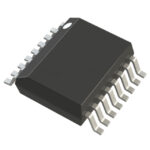 MAX31760AEE+

The activity of extra discounts on wholesale prices is in full swing…
Please fill in your contact information and we will send you the latest wholesale price list.





