 ChipApex | Global Electronic Components Supplier
SEARCH
Search Product
Search Post
— IC芯片 | 连接器 | 传感器 | 被动器件 —
Search productSearch post
— IC芯片 | 连接器 | 传感器 | 被动器件 —
Consult the customer manager about the wholesale price.
consultation hotline:86-132-6715-2157
email:[email protected]
Contact the product manager for consultation. One-stop consultation is available.
Do you want a lower wholesale price? Please send us your inquiry and we will reply immediately.
The MAX3224ECAP+T is a dual RS-232 transceiver from the MAX3224E family, manufactured by Analog Devices (Maxim Integrated). It operates on a single +3.0V to +5.5V supply and features AutoShutdown Plus technology, achieving a typical supply current of 1μA when inactive. The device guarantees a data rate of 250kbps with worst-case loads of 3kΩ in parallel with 1000pF. It includes two drivers and two receivers, providing full-duplex communication. Enhanced ESD protection is rated at ±15kV via the Human Body Model and IEC 1000-4-2 Air-Gap Discharge. The component is housed in a 20-pin SSOP package and supports an operating temperature range of 0°C to +70°C.
Verify the specific suffix 'CAP' corresponds to the 20-pin SSOP package and the 'E' designation confirms the commercial temperature range of 0°C to +70°C. Confirm that the '+T' suffix indicates tape-and-reel packaging if reel quantity is required for assembly. Ensure the source document explicitly lists this exact part number variant to avoid confusion with industrial or automotive temperature grades.
Select the MAX3224ECAP+T when a dual-channel RS-232 interface is needed with strict power constraints. This model provides 250kbps throughput, which is sufficient for standard modem communications but distinct from the 1Mbps MegaBaud variants like the MAX3225E. The SSOP package is suitable for space-constrained designs where surface-mount assembly is preferred over through-hole DIP options.
This component belongs to the MAX3224E/MAX3225E/MAX3226E/MAX3227E/MAX3244E/MAX3245E family of 3V-powered RS-232 transceivers. While sharing the same core architecture and AutoShutdown Plus feature, other members differ in channel count (single vs. triple) and guaranteed data rates (250kbps vs. 1Mbps). The MAX3224E specifically defines the dual-driver, dual-receiver configuration within this series.
The MAX3224EEAP+ serves as a direct functional replacement offering the same electrical specifications but extended to the industrial temperature range of -40°C to +85°C. Designers must verify thermal requirements before substituting the ECAP variant with the EEAP version.
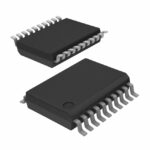 MAX3224ECAP+T
The activity of extra discounts on wholesale prices is in full swing…
Please fill in your contact information and we will send you the latest wholesale price list.







