 ChipApex | Global Electronic Components Supplier
SEARCH
Search Product
Search Post
— IC芯片 | 连接器 | 传感器 | 被动器件 —
Search productSearch post
— IC芯片 | 连接器 | 传感器 | 被动器件 —
Consult the customer manager about the wholesale price.
consultation hotline:86-132-6715-2157
email:[email protected]
Contact the product manager for consultation. One-stop consultation is available.
Do you want a lower wholesale price? Please send us your inquiry and we will reply immediately.
The MAX3238IPWG4Q1 is a multichannel RS-232 line driver and receiver designed for automotive applications, featuring AEC-Q100 qualification. It operates on a single 3-V to 5.5-V supply and integrates five drivers and three receivers for full-duplex communication. The device supports data rates up to 250 kb/s with a propagation delay of 150 ns. It includes a shutdown mode that reduces operating supply current to approximately 2 µA. The component provides ±15-kV electrostatic discharge (ESD) protection per human body model standards. It is housed in a 28-pin TSSOP package and functions within an industrial temperature range of -40°C to +85°C.
Verify the specific suffix G4 indicates lead-free and RoHS compliance status according to Texas Instruments documentation. Confirm the Q1 designation aligns with required automotive qualification standards for the target application. Ensure the TSSOP-28 package dimensions match the printed circuit board layout constraints. Validate the operating temperature range meets the environmental specifications of the final assembly.
Select this component when automotive certification is mandatory for RS-232 interface designs. Choose this part over standard commercial variants if extended temperature stability and shock resistance are required. Consider the five-driver and three-receiver configuration for complex multi-port serial architectures. Evaluate the 250 kb/s speed limit to ensure compatibility with the system's baud rate requirements.
This device belongs to the MAX3238 family of multichannel transceivers from Texas Instruments. It shares functional similarities with other RS-232 interface ICs but distinguishes itself through automotive qualification. The Q1 suffix denotes its suitability for automotive electronics, differentiating it from non-qualified commercial counterparts like the standard MAX3238IPW.
The MAX3238IDB serves as a pin-compatible alternative within the same family, though it lacks automotive qualification. Verify package equivalence between TSSOP-28 variants before substitution. Cross-reference electrical parameters to ensure compatibility with existing circuit designs.
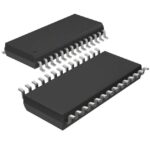 MAX3238IPWG4Q1
The activity of extra discounts on wholesale prices is in full swing…
Please fill in your contact information and we will send you the latest wholesale price list.





