 ChipApex | Global Electronic Components Supplier
SEARCH
Search Product
Search Post
— IC芯片 | 连接器 | 传感器 | 被动器件 —
Search productSearch post
— IC芯片 | 连接器 | 传感器 | 被动器件 —
Consult the customer manager about the wholesale price.
consultation hotline:86-132-6715-2157
email:[email protected]
Contact the product manager for consultation. One-stop consultation is available.
Do you want a lower wholesale price? Please send us your inquiry and we will reply immediately.
The MAX3243CDWRG4 is a low-power RS-232 transceiver manufactured by Texas Instruments, housed in a 28-pin SOIC package. It integrates three drivers and five receivers for full-duplex communication with data rates up to 250 kbps. The device operates on a single 3 V to 5.5 V supply and features a shutdown mode that reduces current consumption to less than 1 µA. It includes ESD protection rated at 15 kV according to the Human Body Model and meets EIA/TIA-232-F standards. The component supports operation across an industrial temperature range of -40°C to +85°C.
Verify the specific suffix G4 indicates lead-free compliance and RoHS adherence when sourcing. Confirm the CDWR variant matches the required commercial-to-industrial temperature range and SOIC-28 footprint for your PCB layout. Ensure compatibility with existing 3V or 5V logic levels before finalizing procurement specifications.
Select this component when designing systems requiring multiple transmit and receive channels without external charge pumps. Compare against the MAX3243EIDWRG4 if extended industrial temperature ranges are necessary. Evaluate the TRS3243 series if alternative packaging options like SSOP are preferred for space-constrained designs.
This part belongs to the MAX3243 family of multichannel RS-232 line drivers and receivers. It shares functional similarities with the MAX3243CDWR but includes the G4 suffix denoting green/RoHS-compliant manufacturing processes. The device is part of Texas Instruments' broader portfolio of interface solutions designed for serial data transmission.
The MAX3243CDWR serves as the direct non-RoHS equivalent. For pin-compatible alternatives, consider the MAX3243EIDWRG4 for wider temperature tolerance or the TRS3243IPWRG4 for SSOP packaging options.
Yes, the device requires four external 0.1 µF capacitors to support the internal charge pump circuitry for generating the required RS-232 voltage levels.
The datasheet specifies a maximum data rate of 250 kbps for reliable operation under standard conditions.
Driving the shutdown pin high disables both the drivers and the charge pump, reducing the supply current to less than 1 µA while maintaining receiver functionality.
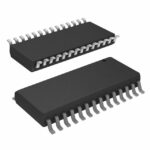 MAX3243CDWRG4
The activity of extra discounts on wholesale prices is in full swing…
Please fill in your contact information and we will send you the latest wholesale price list.







