 ChipApex | Global Electronic Components Supplier
SEARCH
Search Product
Search Post
— IC芯片 | 连接器 | 传感器 | 被动器件 —
Search productSearch post
— IC芯片 | 连接器 | 传感器 | 被动器件 —
Consult the customer manager about the wholesale price.
consultation hotline:86-132-6715-2157
email:[email protected]
Contact the product manager for consultation. One-stop consultation is available.
Do you want a lower wholesale price? Please send us your inquiry and we will reply immediately.
The MAX3243IDWRE4 is a low-power RS-232 transceiver manufactured by Texas Instruments, designed for multi-channel communication applications. It integrates three drivers and five receivers within a single SOIC-28 package, supporting full-duplex data transmission at rates up to 250 kb/s. The device operates on a single 3 V to 5.5 V power supply with a typical operating current of 1 mA. Key electrical specifications include a propagation delay of 0.15 µs and 15 kV ESD protection on all lines. It functions reliably across an industrial temperature range from -40°C to +85°C and includes a shutdown mode to minimize power consumption during idle periods.
Verify the specific suffix 'RE4' against official manufacturer documentation to confirm tape-and-reel packaging and RoHS compliance status. Ensure the ordering part number matches the exact package variant required for your PCB footprint. Cross-reference the datasheet revision history to validate any changes in mechanical dimensions or electrical characteristics prior to final procurement decisions.
Select this component when designing circuits that require multiple RS-232 channels within a compact surface-mount form factor. The SOIC-28 package offers a balance between pin count and board space efficiency. Consider the 250 kb/s data rate limit and the 3 V to 5.5 V operating voltage range to ensure compatibility with the target system's logic levels and power infrastructure.
This part belongs to the MAX3243 family of multi-channel RS-232 transceivers from Texas Instruments. The family provides various package options including SOIC, SSOP, and TSSOP, catering to different density and thermal requirements. The IDWRE4 designation specifically indicates the industrial temperature grade, wide SOIC package, and reel-based packaging format.
Direct replacements within the same series include MAX3243IDWR and MAX3243IDW. Verify pinout compatibility and electrical parameters before substituting. Other variants like MAX3243EIDWR offer higher data rates but may require different decoupling strategies.
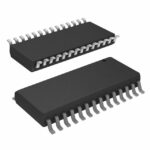 MAX3243IDWRE4
The activity of extra discounts on wholesale prices is in full swing…
Please fill in your contact information and we will send you the latest wholesale price list.





