 ChipApex | Global Electronic Components Supplier
SEARCH
Search Product
Search Post
— IC芯片 | 连接器 | 传感器 | 被动器件 —
Search productSearch post
— IC芯片 | 连接器 | 传感器 | 被动器件 —
Consult the customer manager about the wholesale price.
consultation hotline:86-132-6715-2157
email:[email protected]
Contact the product manager for consultation. One-stop consultation is available.
Do you want a lower wholesale price? Please send us your inquiry and we will reply immediately.
The MAX3250CAI+T is a dual-die, ±50V isolated RS-232 transceiver operating on a single 3.0V to 5.5V logic supply. It features two drivers and two receivers with a guaranteed data rate of 250kbps. Power transfers across the isolation barrier via external ±100V capacitors (C1, C2). The device includes a FAULT open-drain output for overvoltage indication and a shutdown mode drawing 20µA. It operates within a commercial temperature range of 0°C to +70°C and is housed in a 28-pin SSOP package.
Verify the specific suffix CAI+T corresponds to the commercial temperature range (0°C to +70°C) and lead-free/RoHS compliance status. Confirm the package type matches the 28-pin SSOP outline. Ensure ordering documentation aligns with the manufacturer's current revision history to avoid discrepancies in electrical characteristics or pin definitions.
Select this component when high common-mode voltage tolerance is required without using optical or magnetic isolation. Verify that external capacitor values meet the minimum ratings for the intended supply voltage. Consider the 250kbps speed limit and ensure the application does not require higher baud rates. Evaluate the need for the FAULT monitoring feature in the system design.
The MAX3250 is part of the Maxim Integrated RS-232 interface family designed for noisy environments. It utilizes proprietary low-dropout transmitter stages and dual charge pumps to generate true RS-232 levels from low-voltage supplies. The device simplifies EMI compliance through its inductorless and transformerless design architecture.
Direct replacements include the MAX3250EAI+ for extended industrial temperature ranges (-40°C to +85°C). Other variants in the series may offer different pin counts or speeds but lack the specific ±50V isolation capability integrated into this dual-die architecture.
Power is transferred from the logic side to the isolated side using external ±100V capacitors connected between pins C1+/C1- and C2+/C2-. These capacitors rectify high-frequency square waves generated by the internal oscillator.
Driving the SHDN pin low places the device in low-power shutdown mode, reducing supply current to typically 20µA. In this state, transmitter and receiver outputs become high impedance, allowing other devices to connect to the same UART.
If the voltage difference between GND and ISOCOM exceeds approximately 55V, the FAULT output goes active (low). This open-drain signal can be monitored by a processor to alert of potential damage or abnormal operation.
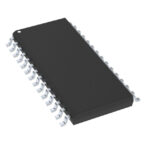 MAX3250CAI+T
The activity of extra discounts on wholesale prices is in full swing…
Please fill in your contact information and we will send you the latest wholesale price list.





