 ChipApex | Global Electronic Components Supplier
SEARCH
Search Product
Search Post
— IC芯片 | 连接器 | 传感器 | 被动器件 —
Search productSearch post
— IC芯片 | 连接器 | 传感器 | 被动器件 —
Consult the customer manager about the wholesale price.
consultation hotline:86-132-6715-2157
email:[email protected]
Contact the product manager for consultation. One-stop consultation is available.
Do you want a lower wholesale price? Please send us your inquiry and we will reply immediately.
The MAX33042EASA+ is a +5V, half-duplex CAN transceiver manufactured by Analog Devices Inc./Maxim Integrated. It supports data rates up to 4Mbps and operates within a supply voltage range of 4.5V to 5.5V. The device features ±40V fault protection on the CANH and CANL pins, ±40kV ESD Human Body Model (HBM) protection, and an extended common-mode input range of ±25V. It includes a transmitter-dominant timeout mechanism to prevent bus lockup. The component is housed in an 8-pin SOIC package and functions reliably across an operating temperature range of -40°C to +125°C.
Verify the specific ordering suffix to confirm the package type, as the base part number covers multiple options. Ensure the selected variant matches the required PCB footprint, such as the 8-pin SOIC configuration for this specific model. Confirm RoHS compliance status through official manufacturer documentation before finalizing procurement specifications.
Select this component when designing CAN networks requiring high noise immunity and overvoltage protection. The ±25V common-mode range makes it suitable for systems with significant ground potential differences. Consider the available standby and shutdown modes if power efficiency is a critical design constraint for the application.
This component belongs to the MAX33042 family of CAN transceivers designed for harsh industrial environments. The series provides integrated protection against electrical stress, ensuring reliable communication. The MAX33042EASA+ specifically denotes the lead-free, RoHS-compliant version packaged in an 8-pin small outline integrated circuit format.
The MAX33042EAKA+ serves as a direct functional alternative utilizing an 8-pin SOT23 package instead of the SOIC form factor. Both variants share identical electrical characteristics and pinout configurations, allowing for potential board layout adjustments without changing the core circuit design.
The MAX33042EASA+ incorporates a transmitter-dominant timeout mechanism. If the TXD input remains in the dominant state for longer than the specified timeout period, the driver automatically switches to the recessive state to release the bus.
The STBY pin controls the operational mode. Driving it high enables a low-current standby mode, while connecting it to ground via a 26.1kΩ resistor activates a slow slew rate mode to reduce electromagnetic interference.
Yes, the typical application circuit demonstrates compatibility with standard multidrop CAN bus topologies, which require 60Ω termination resistors at each end of the linear bus segment.
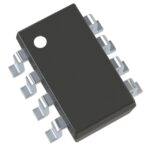 MAX33042EASA+
The activity of extra discounts on wholesale prices is in full swing…
Please fill in your contact information and we will send you the latest wholesale price list.





