 ChipApex | Global Electronic Components Supplier
SEARCH
Search Product
Search Post
— IC芯片 | 连接器 | 传感器 | 被动器件 —
Search productSearch post
— IC芯片 | 连接器 | 传感器 | 被动器件 —
Consult the customer manager about the wholesale price.
consultation hotline:86-132-6715-2157
email:[email protected]
Contact the product manager for consultation. One-stop consultation is available.
Do you want a lower wholesale price? Please send us your inquiry and we will reply immediately.
The MAX33074EASA+T is a half-duplex RS-485/RS-422 transceiver from Analog Devices. It supports data rates up to 20Mbps and operates on a single supply voltage ranging from +3V to +5.5V. The device features ±65V fault protection on driver outputs and receiver inputs, along with a ±40V common-mode range. It incorporates ±40kV ESD Human Body Model protection on the A and B lines. The unit includes one driver and one receiver in an 8-pin SO package with an exposed pad, functioning within a temperature range of -40°C to +125°C.
Verify the specific ordering suffix against official documentation to confirm package type and RoHS compliance status. Confirm that the component matches the required thermal resistance specifications for your PCB layout. Ensure the supplier provides valid traceability documents for the manufacturing lot. Cross-reference the part number with the manufacturer's latest datasheet revision to ensure feature consistency.
Select this component for applications requiring high-speed data transmission up to 20Mbps alongside significant overvoltage tolerance. The wide common-mode range makes it suitable for systems with large ground potential differences. Consider the exposed pad package for improved thermal dissipation during high-duty-cycle transmissions. Verify that the system power supply falls within the specified 3V to 5.5V operating range.
This device belongs to the MAX33070E/MAX33071E/MAX33074E family of fault-protected transceivers. While sharing similar protection features, the MAX33074E is distinguished by its higher maximum data rate of 20Mbps compared to the 500kbps and 2Mbps variants. All members of this series offer identical ±65V fault protection and ±40V common-mode ranges.
MAX33070EASA+T
When a fault condition persists, the driver output is disabled for approximately 300ms before being re-enabled for 30μs to test if the fault has cleared.
It safeguards against unwanted driver activation during board insertion by holding the DE input low for at least 10μs as VCC rises.
Thermal shutdown activates when the internal silicon junction temperature exceeds +160°C, disabling the driver outputs until the temperature falls below +148°C.
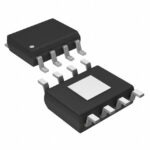 MAX33074EASA+T
The activity of extra discounts on wholesale prices is in full swing…
Please fill in your contact information and we will send you the latest wholesale price list.





