 ChipApex | Global Electronic Components Supplier
SEARCH
Search Product
Search Post
— IC芯片 | 连接器 | 传感器 | 被动器件 —
Search productSearch post
— IC芯片 | 连接器 | 传感器 | 被动器件 —
Consult the customer manager about the wholesale price.
consultation hotline:86-132-6715-2157
email:[email protected]
Contact the product manager for consultation. One-stop consultation is available.
Do you want a lower wholesale price? Please send us your inquiry and we will reply immediately.
The MAX3318EIDBR is a dual-driver, dual-receiver RS-232 transceiver manufactured by Texas Instruments. It operates from a single 2.25-V to 3-V supply and supports data rates up to 460 kbps. The device integrates a charge pump requiring only four 0.1-μF capacitors. It features ±15-kV ESD protection on RS-232 I/O pins using the IEC 61000-4-2 Air-Gap Discharge method. Supply current is 300 μA during operation and reduces to 1 μA in low-power standby mode with receivers active. It is housed in a 20-pin SSOP package.
Verify the specific ordering suffix 'IDBR' corresponds to the industrial temperature range (-40°C to +85°C) and the SSOP (DB) package type as defined in the TI Package Option Addendum. Confirm that the RoHS status is compliant and check the lead finish specifications (NIPDAU) against assembly requirements. Ensure the moisture sensitivity level (MSL Level-1) aligns with your board manufacturing process capabilities.
Select this component when designing serial communication interfaces for low-voltage microcontrollers requiring RS-232 compatibility without external voltage inversion circuits. The integrated charge pump minimizes external component count. Consider the auto-power-down functionality for battery-operated applications where power conservation is critical during periods of inactivity.
The MAX3318EIDBR belongs to the MAX3318 family of RS-232 transceivers. This series is designed for portable electronics needing reliable serial communication over short distances. The 'E' designation indicates enhanced ESD protection compared to earlier generations. The device replaces older solutions that required higher supply voltages or multiple external components for charge pumping.
MAX3318EIDB is the tube version of the same electrical specification.
When FORCEON is high and FORCEOFF is low, the device monitors receiver and driver inputs. If no valid signal transitions occur for approximately 30 seconds, the charge pump and drivers power down, reducing supply current to 1 μA. The device reactivates upon detecting a valid transition.
The INVALID pin indicates the status of the receiver input signals. It goes high if any receiver input voltage is greater than 2.7 V or less than -2.7 V, indicating a valid RS-232 level. It goes low if all receiver inputs remain between -0.3 V and 0.3 V for more than 30 μs.
Yes, auto-power-down plus can be disabled by driving both FORCEON and FORCEOFF high. In this state, the transmitters remain active regardless of input activity, preventing the device from entering the low-power shutdown mode.
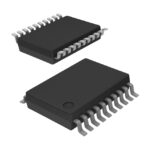 MAX3318EIDBR
The activity of extra discounts on wholesale prices is in full swing…
Please fill in your contact information and we will send you the latest wholesale price list.





