 ChipApex | Global Electronic Components Supplier
SEARCH
Search Product
Search Post
— IC芯片 | 连接器 | 传感器 | 被动器件 —
Search productSearch post
— IC芯片 | 连接器 | 传感器 | 被动器件 —
Consult the customer manager about the wholesale price.
consultation hotline:86-132-6715-2157
email:[email protected]
Contact the product manager for consultation. One-stop consultation is available.
Do you want a lower wholesale price? Please send us your inquiry and we will reply immediately.
The MAX3440EESA+ is a half-duplex RS-485 transceiver manufactured by Analog Devices Inc. under the Maxim Integrated brand, housed in an 8-pin SO package. It operates from a 5V supply (4.75V to 5.25V) with a maximum data rate of 250kbps and features ±15kV ESD protection on pins A and B. The device includes one driver and one receiver, supports up to 128 units on a bus via 1/4-unit-load impedance, and provides ±60V fault protection. It functions within an industrial temperature range of -40°C to +85°C.
Verify the component against official datasheets to confirm lead-free status and RoHS compliance. Ensure the specific suffix matches the required operating temperature range and package type. Cross-reference pin configurations and electrical characteristics with the manufacturer's documentation before integration.
Select this model when designing systems requiring robust fault protection against high-voltage bus errors. The enhanced slew-rate limiting makes it suitable for applications where minimizing electromagnetic emissions is critical. Verify that the 250kbps data rate meets the system requirements, as higher-speed variants exist within the same family.
This component belongs to the MAX3440E–MAX3444E series of fault-protected transceivers. The 'E' suffix indicates an extended automotive temperature range capability, while the 'ES' denotes the 8-pin Small Outline package. The '+' suffix signifies a lead-free and RoHS-compliant manufacturing process.
The MAX3440EASA+ serves as a direct replacement offering an extended automotive temperature range (-40°C to +125°C). Other compatible devices within the series include the MAX3441E for higher data rates and the MAX3442E which includes low-power shutdown functionality.
The FAULT pin outputs a logic-high signal when the device detects a fault condition, such as a differential voltage below 200mV, a short between A and B, or voltages outside the -7V to +12V common-mode range.
Internal circuitry holds the driver enable input low for at least 10µs after power-up, preventing unintended driver activation and data bus disturbances when the board is inserted into a powered backplane.
Slew-rate limiting reduces electromagnetic interference (EMI) and minimizes signal reflections caused by improperly terminated cables, facilitating error-free data transmission.
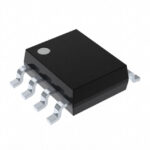 MAX3440EESA+
The activity of extra discounts on wholesale prices is in full swing…
Please fill in your contact information and we will send you the latest wholesale price list.







