 ChipApex | Global Electronic Components Supplier
SEARCH
Search Product
Search Post
— IC芯片 | 连接器 | 传感器 | 被动器件 —
Search productSearch post
— IC芯片 | 连接器 | 传感器 | 被动器件 —
Consult the customer manager about the wholesale price.
consultation hotline:86-132-6715-2157
email:[email protected]
Contact the product manager for consultation. One-stop consultation is available.
Do you want a lower wholesale price? Please send us your inquiry and we will reply immediately.
The MAX3442EESA+T is a half-duplex RS-485 transceiver in an 8-pin SO package. It operates from a 4.75V to 5.25V supply with a typical current of 30mA. The device supports data rates up to 250kbps and features ±15kV ESD protection on A/B pins. It includes ±60V fault protection, true fail-safe inputs guaranteeing a logic-high output when idle, and hot-swap capability for telecom applications. Enhanced slew-rate limiting minimizes EMI. It functions within -40°C to +85°C.
Verify the specific suffix 'T' indicates tape-and-reel packaging versus the standard tube configuration found in datasheet tables. Confirm the component meets RoHS compliance standards as indicated by the '+' designation. Ensure the ordering code matches the exact temperature range and package dimensions required for the target PCB layout.
Select this model for applications requiring low-speed (250kbps) transmission with enhanced noise immunity. The slew-rate limiting makes it suitable for longer bus lines or improperly terminated cables where high-speed variants might cause signal integrity issues. Verify that the 5V supply voltage aligns with the system power architecture.
This component belongs to the MAX3440E–MAX3444E family of fault-protected transceivers. While sharing core protection features like ±60V tolerance and hot-swap inputs, the MAX3442E specifically offers reduced data rates compared to the MAX3441E/MAX3443E. It utilizes separate DE and RE control pins rather than a combined DE/RE pin.
The MAX3440E provides similar functionality but lacks the low-power shutdown mode. The MAX3444E is designed for J1708 protocols with different input configurations. Cross-reference pinouts and control logic states before substituting with other members of the MAX344x series.
It employs short-circuit current-limiting and thermal shutdown circuitry to protect the driver against excessive power dissipation during bus faults.
The FAULT pin outputs a logic-high signal when specific fault conditions occur, such as differential voltage below thresholds or common-mode voltages outside the specified range.
Yes, internal circuitry holds the driver enable low during power-up to prevent unwanted activation when connecting to a live backplane.
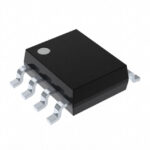 MAX3442EESA+T
The activity of extra discounts on wholesale prices is in full swing…
Please fill in your contact information and we will send you the latest wholesale price list.





