 ChipApex | Global Electronic Components Supplier
SEARCH
Search Product
Search Post
— IC芯片 | 连接器 | 传感器 | 被动器件 —
Search productSearch post
— IC芯片 | 连接器 | 传感器 | 被动器件 —
Consult the customer manager about the wholesale price.
consultation hotline:86-132-6715-2157
email:[email protected]
Contact the product manager for consultation. One-stop consultation is available.
Do you want a lower wholesale price? Please send us your inquiry and we will reply immediately.
The MAX3443ECSA+ is a half-duplex RS-485 transceiver manufactured by Analog Devices Inc./Maxim Integrated. It operates from a single +4.75V to +5.25V supply and supports data rates up to 10Mbps. The device integrates one differential driver and one differential receiver within an 8-pin SOIC package. Key electrical specifications include ±15kV ESD protection on the A and B pins, ±60V fault protection capability, and a true fail-safe receiver input that guarantees a logic-high output when inputs are open or shorted. The component features hot-swap circuitry for telecom applications and low-power shutdown mode.
Verify the specific suffix 'CSA+' against official manufacturer documentation to confirm exact temperature range and packaging details. Ensure compatibility with existing board layouts regarding the 8-pin SOIC footprint. Confirm RoHS compliance status through current datasheets before finalizing procurement orders.
Select this component for designs requiring high-speed data transmission up to 10Mbps with robust fault protection. The MAX3443E variant specifically offers guaranteed 10Mbps performance unlike slew-rate limited models. Consider the automotive temperature range if operating in harsh environments. Verify pinout compatibility with industry-standard RS-485 interfaces.
This part belongs to the MAX3440E–MAX3444E family of fault-protected transceivers. The MAX3443E designation indicates support for data rates up to 10Mbps with separate Driver Enable (DE) and Receiver Enable (RE) control pins. It is designed for multipoint bus transmission lines where high noise immunity and fault tolerance are critical.
MAX3443EESA+
The FAULT pin outputs a logic high signal when a fault condition is detected on the A or B lines, such as a short between them or voltages outside the common-mode range.
Internal circuitry holds the DE input low until VCC rises sufficiently, preventing unwanted driver activation and data errors during board insertion into a live backplane.
The 1/4-unit-load receiver input impedance allows up to 128 transceivers to be connected on a single communication bus.
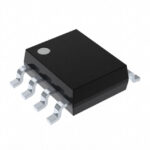 MAX3443ECSA+
The activity of extra discounts on wholesale prices is in full swing…
Please fill in your contact information and we will send you the latest wholesale price list.





