 ChipApex | Global Electronic Components Supplier
SEARCH
Search Product
Search Post
— IC芯片 | 连接器 | 传感器 | 被动器件 —
Search productSearch post
— IC芯片 | 连接器 | 传感器 | 被动器件 —
Consult the customer manager about the wholesale price.
consultation hotline:86-132-6715-2157
email:[email protected]
Contact the product manager for consultation. One-stop consultation is available.
Do you want a lower wholesale price? Please send us your inquiry and we will reply immediately.
The MAX3624UTJ2T is a low-jitter precision clock generator optimized for networking applications. It integrates a crystal oscillator and a phase-locked loop (PLL) clock multiplier to generate high-frequency outputs for Ethernet, Fibre Channel, SONET/SDH, and other networking applications. The device features ultra-low jitter of 0.36ps RMS and excellent power-supply noise rejection. It provides three LVPECL outputs and one LVCMOS output with selectable dividers. Operating voltage ranges from 3V to 3.6V, with an operating temperature range of 0°C to +85°C in a 32-TQFN package.
Verify the ordering suffix 'UTJ2T' against official Microchip or Maxim Integrated documentation to confirm specific tape-and-reel packaging and temperature grade details. Ensure compatibility with the 32-TQFN exposed pad thermal requirements during assembly.
Select this component when designing systems requiring precise clock synthesis for Ethernet, Fibre Channel, or SONET/SDH interfaces. Consider the available output frequencies (e.g., 125MHz, 156.25MHz, 312.5MHz) and the need for LVPECL versus LVCMOS signaling levels. Verify that the input reference source matches the supported crystal or CMOS input specifications.
The MAX3624 is part of Maxim Integrated's (now Microchip Technology) portfolio of low-jitter clock generators. It is designed to minimize design risk in network equipment by providing a proprietary PLL architecture with integrated oscillators. The device simplifies board layout by eliminating the need for external loop filter capacitors.
Publicly confirmed substitute part numbers are not available in the provided documentation. Evaluate alternative clock generators based on matching jitter performance, output types (LVPECL/LVCMOS), and package dimensions if substitution is required.
The LVPECL outputs (QA, QB0, QB1) are specified up to 320MHz.
No, the device does not require an external loop filter capacitor.
The VCO supply (VCCA) can be isolated from the core logic using a recommended filter network consisting of a 10.5Ω resistor and decoupling capacitors, provided the power supply is +3.3V ±5%.
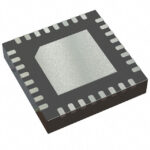 MAX3624UTJ2T
The activity of extra discounts on wholesale prices is in full swing…
Please fill in your contact information and we will send you the latest wholesale price list.





