 ChipApex | Global Electronic Components Supplier
SEARCH
Search Product
Search Post
— IC芯片 | 连接器 | 传感器 | 被动器件 —
Search productSearch post
— IC芯片 | 连接器 | 传感器 | 被动器件 —
Consult the customer manager about the wholesale price.
consultation hotline:86-132-6715-2157
email:[email protected]
Contact the product manager for consultation. One-stop consultation is available.
Do you want a lower wholesale price? Please send us your inquiry and we will reply immediately.
The MAX4373HEUA+ is a low-cost, micropower high-side current-sense supervisor featuring an integrated amplifier, comparator with latching output, and bandgap reference. It operates from a single +2.7V to +28V supply with a 50µA typical supply current. The device provides a voltage output proportional to the sense resistor voltage drop, eliminating external gain-setting resistors. It features a 0V to +28V common-mode input range independent of supply voltage, ensuring functionality during deep battery discharge. The unit offers a fixed gain of +100V/V, a maximum input offset voltage of 1mV, and a full-scale accuracy of 2%. It is housed in an 8-pin µMAX package.
Verify that the specific part number suffix corresponds to the µMAX package type rather than SOIC variants. Confirm the gain version matches the required application sensitivity (+100V/V). Ensure the ordering code includes the lead-free designation if RoHS compliance is mandatory for the manufacturing process.
Select this component when high-side monitoring is required without disturbing the ground path. The fixed +100V/V gain suits applications requiring higher resolution for smaller sense voltages. Consider the latching output feature if system stability against transient noise during fault conditions is critical compared to non-latching alternatives.
This device belongs to the MAX4373/MAX4374/MAX4375 family of supervisors. While the MAX4373 contains one comparator, the MAX4374 and MAX4375 include a second comparator for window detection functions. All variants share the same core current-sense amplifier architecture and power specifications.
Direct substitutes within the same series include MAX4373TEUA+ (Gain +20V/V) and MAX4373FEUA+ (Gain +50V/V). These parts maintain identical pinouts and package dimensions but differ in internal amplifier gain settings.
Holding the RESET pin low activates transparency, allowing the output to follow the CIN1 input. Pulsing RESET low for at least 1.5µs resets the internal latch after a trip event.
The common-mode input range extends to 0V independently of the supply voltage, allowing the device to monitor current even when the battery pack is deeply discharged.
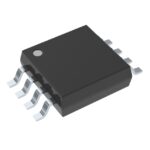 MAX4373HEUA
The activity of extra discounts on wholesale prices is in full swing…
Please fill in your contact information and we will send you the latest wholesale price list.







