 ChipApex | Global Electronic Components Supplier
SEARCH
Search Product
Search Post
— IC芯片 | 连接器 | 传感器 | 被动器件 —
Search productSearch post
— IC芯片 | 连接器 | 传感器 | 被动器件 —
Consult the customer manager about the wholesale price.
consultation hotline:86-132-6715-2157
email:[email protected]
Contact the product manager for consultation. One-stop consultation is available.
Do you want a lower wholesale price? Please send us your inquiry and we will reply immediately.
The MAX4374FESD-T is a low-cost, micropower high-side current-sense supervisor featuring an integrated amplifier, comparator, and bandgap reference. It operates from a single +2.7V to +28V supply with a 0 to +28V common-mode input range independent of supply voltage. The device provides a voltage output proportional to the sense resistor voltage drop, eliminating external gain-setting resistors. It includes a latching comparator output for overcurrent protection and a second comparator for window detection functions.
Verify the specific suffix 'T' indicates tape-and-reel packaging configuration when sourcing. Confirm the 'F' designation corresponds to the +50V/V gain version required for the application. Ensure the component meets RoHS compliance standards as indicated by the '+' symbol in standard ordering part numbers. Cross-reference the package type with the datasheet pinout diagrams to ensure compatibility with the target PCB footprint.
Select this model for applications requiring a +50V/V gain setting. The device supports both high-side monitoring without interfering with ground paths and low-side sensing. Consider the extended temperature range specifications for harsh environments. Evaluate the need for the second comparator if window detection is necessary, distinguishing it from the single-comparator MAX4373 variant.
This component belongs to the MAX4373/MAX4374/MAX4375 family of current-sense supervisors. The MAX4374 specifically adds a second comparator compared to the MAX4373, enabling window detection capabilities. The family shares identical core amplifier characteristics but differs in comparator count and gain options. These devices are designed to simplify current monitoring in portable electronics by integrating multiple functions into a single compact package.
MAX4374FEUA+ (µMAX package)
The comparator output latches into an open state when the CIN1 input exceeds the internal reference threshold. This state persists even if the input drops below the threshold until the RESET pin is pulsed low for at least 1.5µs.
The second comparator allows for window-detection functions. By connecting COUT1 and COUT2, the device can indicate whether the load current is within a specific upper and lower limit window.
Yes, although total output voltage error increases when the RS+ voltage falls below 2V. The device is primarily optimized for high-side monitoring where the common-mode range remains functional down to 0V.
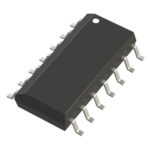 MAX4374FESD-T
The activity of extra discounts on wholesale prices is in full swing…
Please fill in your contact information and we will send you the latest wholesale price list.





