 ChipApex | Global Electronic Components Supplier
SEARCH
Search Product
Search Post
— IC芯片 | 连接器 | 传感器 | 被动器件 —
Search productSearch post
— IC芯片 | 连接器 | 传感器 | 被动器件 —
Consult the customer manager about the wholesale price.
consultation hotline:86-132-6715-2157
email:[email protected]
Contact the product manager for consultation. One-stop consultation is available.
Do you want a lower wholesale price? Please send us your inquiry and we will reply immediately.
The MAX4375TESD+T is a low-cost, micropower high-side current-sense supervisor integrating a current-sense amplifier, bandgap reference, and comparator with latching output. It operates from a single +2.7V to +28V supply with a typical supply current of 50µA. The device features a +20V/V gain version, a 0V to +28V common-mode input range independent of supply voltage, and an internal 600mV comparator threshold. It is specified for operation between -40°C and +85°C in a 14-pin SO package.
Verify the specific suffix 'SD' corresponds to the 14-pin SO package configuration required for your PCB layout. Confirm the 'T' indicates tape-and-reel packaging if automated assembly is utilized. Ensure the '+T' designation aligns with RoHS compliance requirements for your manufacturing process. Cross-reference the exact part number against the manufacturer's latest ordering guide to confirm availability status.
Select this component when high-side monitoring is necessary to avoid interfering with the ground path of battery chargers. The integrated latching comparator simplifies overcurrent protection circuits by preventing oscillation. Choose the +20V/V gain variant when designing for larger sense resistors or lower full-scale voltage requirements compared to higher gain options.
This device belongs to the MAX4373/MAX4374/MAX4375 family of micropower current-sense supervisors. While the MAX4373 offers a single comparator, the MAX4375 adds a second comparator for window detection. All variants share the same core amplifier architecture and power specifications but differ in pin count and comparator functionality based on the package type.
MAX4374TESD+T
The device utilizes a latching comparator output. Once the CIN1 input exceeds the 600mV threshold, the output latches into the open state, providing a stable turn-off flag until the RESET pin is pulsed low.
The second comparator, accessible via the CIN2 and COUT2 pins, enables window-detection functions. It allows the system to monitor if the load current falls within a specific upper and lower limit range.
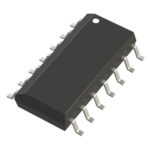 MAX4375TESD+T
The activity of extra discounts on wholesale prices is in full swing…
Please fill in your contact information and we will send you the latest wholesale price list.





