 ChipApex | Global Electronic Components Supplier

SEARCH
Search Product
Search Post
— IC芯片 | 连接器 | 传感器 | 被动器件 —
Search productSearch post
— IC芯片 | 连接器 | 传感器 | 被动器件 —
Consult the customer manager about the wholesale price.
consultation hotline:86-132-6715-2157
email:[email protected]
Contact the product manager for consultation. One-stop consultation is available.
Do you want a lower wholesale price? Please send us your inquiry and we will reply immediately.
The MAX5388NAUB+ is a dual, 256-tap, volatile, low-voltage linear taper digital potentiometer manufactured by Analog Devices / Maxim Integrated. It operates from a single +2.6V to +5.5V power supply with a quiescent current of less than 1µA. The device features an SPI-compatible interface and offers three end-to-end resistance values: 10kΩ, 50kΩ, and 100kΩ. Specifically, the NAUB+ variant provides a 100kΩ resistance in a 10-pin µMAX package. It includes one digital potentiometer configured as a voltage divider and another as a variable resistor. The component supports an extended operating temperature range from -40°C to +125°C.
Verify the specific suffix 'NAUB+' against the manufacturer's ordering information to confirm the 100kΩ resistance value and 10-pin µMAX package configuration. Ensure that the volatile memory characteristic aligns with system requirements, as wiper positions reset upon power loss. Confirm RoHS compliance status based on the '+' designation in the part number.
Select the MAX5388NAUB+ when a dual digital potentiometer with mixed configurations (one voltage-divider and one variable-resistor) is required. Choose this 100kΩ variant over the LAUB+ (10kΩ) or MAUB+ (50kΩ) versions if higher resistance values are necessary for the application. Verify that the 10-pin µMAX package dimensions fit the PCB layout constraints compared to the 16-pin TQFN options available in the MAX5386 series.
The MAX5388NAUB+ belongs to the MAX5386/MAX5388 family of dual digital potentiometers. While the MAX5386 offers two voltage-divider configurations, the MAX5388 provides one voltage-divider and one variable-resistor configuration. This family is designed for portable consumer markets and battery-backed industrial applications due to its small package size and low power consumption.
The MAX5386NATE+ serves as a functional alternative within the same family but utilizes a 16-pin TQFN package and provides two voltage-divider configurations instead of the MAX5388's mixed configuration. Direct pin-for-pin replacement requires verifying the package footprint compatibility between the 10-pin µMAX and other available packages.
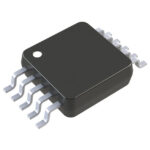 MAX5388NAUB+

The activity of extra discounts on wholesale prices is in full swing…
Please fill in your contact information and we will send you the latest wholesale price list.





