 ChipApex | Global Electronic Components Supplier

SEARCH
Search Product
Search Post
— IC芯片 | 连接器 | 传感器 | 被动器件 —
Search productSearch post
— IC芯片 | 连接器 | 传感器 | 被动器件 —
Consult the customer manager about the wholesale price.
consultation hotline:86-132-6715-2157
email:[email protected]
Contact the product manager for consultation. One-stop consultation is available.
Do you want a lower wholesale price? Please send us your inquiry and we will reply immediately.
The MAX5408EGE+ is a dual-channel digital potentiometer IC from the Maxim Integrated portfolio, now part of Analog Devices. It features two independent 32-tap wiper positions with a logarithmic taper, specifically designed for audio applications. The device operates on a single supply voltage ranging from 2.7V to 3.6V and draws a typical operating current of 100µA. Resistance tolerance is specified at ±30%, with a temperature coefficient of 35ppm/°C. Communication is handled via a standard 3-wire SPI serial interface. The component utilizes volatile memory to store wiper settings, requiring re-initialization upon power cycles.
Verify the specific suffix 'EGE' against official Analog Devices documentation to confirm package type (QSOP-16) and industrial/commercial temperature range. Ensure RoHS compliance status matches project requirements by checking the latest manufacturer declaration. Confirm availability through authorized distributors as lead times may vary based on production status.
Select this component when dual-channel logarithmic attenuation is required for audio signals. The 32-tap resolution provides sufficient granularity for volume control without excessive interface complexity. Verify that the 3.6V maximum supply voltage aligns with the system's power rails. Consider the ±30% resistance tolerance if precise absolute resistance values are critical for the application design.
This part belongs to the MAX5408 family of dual digital potentiometers. It shares functional similarities with other MAX54xx series devices but is distinct due to its logarithmic taper and 32-tap configuration. Unlike non-volatile variants such as the MAX5488, the MAX5408 retains settings only while powered, simplifying the internal architecture and reducing power consumption.
No, the MAX5408 uses volatile memory. Wiper positions are lost when power is removed and must be reprogrammed after each power cycle.
The nominal resistance tolerance is specified as ±30%.
No, the MAX5408 communicates exclusively via a 3-wire SPI serial interface.
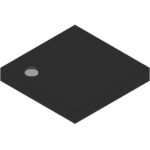 MAX5408EGE

The activity of extra discounts on wholesale prices is in full swing…
Please fill in your contact information and we will send you the latest wholesale price list.





