 ChipApex | Global Electronic Components Supplier

SEARCH
Search Product
Search Post
— IC芯片 | 连接器 | 传感器 | 被动器件 —
Search productSearch post
— IC芯片 | 连接器 | 传感器 | 被动器件 —
Consult the customer manager about the wholesale price.
consultation hotline:86-132-6715-2157
email:[email protected]
Contact the product manager for consultation. One-stop consultation is available.
Do you want a lower wholesale price? Please send us your inquiry and we will reply immediately.
The MAX5408ETE is a dual digital potentiometer IC manufactured by Analog Devices Inc./Maxim Integrated. It features two independent 10 kOhm resistive elements with logarithmic taper characteristics, suitable for audio applications. Each potentiometer offers 32 tap positions controlled via a serial 3-wire or SPI interface. The device operates on a supply voltage ranging from 2.7 V to 3.6 V and consumes 100 uA of operating current. It utilizes volatile brush memory to retain wiper settings during power cycles. The component is housed in a QSOP-16 surface-mount package and supports an industrial temperature range from -40°C to +85°C.
Verify the specific suffix 'ETE' against official Analog Devices documentation to confirm the QSOP-16 package variant. Confirm RoHS compliance status through the manufacturer's certification documents. Check for obsolescence notices as Maxim Integrated products may have lifecycle changes. Ensure the volatile memory requirement aligns with system power management strategies since settings are lost upon power removal.
Select this component when dual independent logarithmic control is required within a 3.3 V logic environment. The 32-step resolution provides coarse adjustment suitable for audio perception rather than precision linear attenuation. Compare against the MAX5410 if higher voltage tolerance (5 V) is needed, or the MAX5488 if non-volatile storage is mandatory. Verify that the QSOP-16 footprint fits the PCB layout constraints compared to TQFN alternatives.
The MAX5408 belongs to the MAX5408/MAX5410 family of dual digital potentiometers designed for analog signal control. Unlike the MAX5410 which supports 5 V supplies, the MAX5408 is optimized for lower voltage 3.3 V systems. The 'ETE' suffix denotes the specific plastic package type and temperature grade. This part serves as a solid-state replacement for mechanical potentiometers in space-constrained designs.
Publicly confirmed substitute part numbers are not available in the provided source material. Engineering teams should consult Analog Devices for current cross-reference data regarding pin-compatible or functionally equivalent replacements.
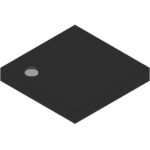 MAX5408ETE

The activity of extra discounts on wholesale prices is in full swing…
Please fill in your contact information and we will send you the latest wholesale price list.





