 ChipApex | Global Electronic Components Supplier

SEARCH
Search Product
Search Post
— IC芯片 | 连接器 | 传感器 | 被动器件 —
Search productSearch post
— IC芯片 | 连接器 | 传感器 | 被动器件 —
Consult the customer manager about the wholesale price.
consultation hotline:86-132-6715-2157
email:[email protected]
Contact the product manager for consultation. One-stop consultation is available.
Do you want a lower wholesale price? Please send us your inquiry and we will reply immediately.
The MAX5435MEZT+T is a nonvolatile, linear-taper digital potentiometer featuring 32 tap points and an end-to-end resistance of 100kΩ. It utilizes a fast-mode I²C-compatible serial interface for communication at data rates up to 400kbps. The device incorporates internal EEPROM to recall the wiper position upon power-up. Operating on a single supply voltage ranging from +2.7V to +5.25V, it consumes typically 0.5µA in standby mode. The component is housed in a 6-pin thin SOT23 package and is specified for operation over an extended temperature range of -40°C to +85°C.
Verify the specific I²C slave address assigned to the MAX5435MEZT+T variant before integration, as factory-programmed addresses vary within the family. Confirm that the 6-pin thin SOT23 package dimensions align with the target PCB footprint. Ensure the design accommodates the required pullup resistors for the SDA and SCL lines to maintain signal integrity during high-speed communication.
Select this component when a 100kΩ variable resistor configuration is required rather than a voltage-divider setup. The MAX5435 internally connects the high terminal to the wiper, distinguishing it from the MAX5433 which exposes all three terminals. Verify that the system's I²C bus supports the necessary addressing scheme, as the A0 pin is not available for address selection on this package type.
This part belongs to the MAX5432–MAX5435 series of 32-tap, nonvolatile, I²C, linear digital potentiometers. While the MAX5432 and MAX5433 are available in 8-pin TDFN packages with exposed pads, the MAX5434 and MAX5435 utilize a compact 6-pin thin SOT23 package. The series shares common electrical characteristics, including low temperature coefficients and nonvolatile storage capabilities.
The MAX5433LEZT+T or MAX5433NEZT+T may serve as functional substitutes if the application requires access to the high terminal for voltage-divider configurations. These alternatives provide the same 100kΩ resistance and 32-tap resolution but differ in pinout by exposing the H terminal instead of connecting it internally to the wiper.
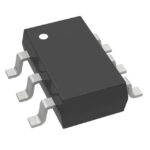 MAX5435MEZT+T

The activity of extra discounts on wholesale prices is in full swing…
Please fill in your contact information and we will send you the latest wholesale price list.





