 ChipApex | Global Electronic Components Supplier

SEARCH
Search Product
Search Post
— IC芯片 | 连接器 | 传感器 | 被动器件 —
Search productSearch post
— IC芯片 | 连接器 | 传感器 | 被动器件 —
Consult the customer manager about the wholesale price.
consultation hotline:86-132-6715-2157
email:[email protected]
Contact the product manager for consultation. One-stop consultation is available.
Do you want a lower wholesale price? Please send us your inquiry and we will reply immediately.
The MAX5454EUB+ is a dual digital potentiometer IC from the MAX5450–MAX5455 family, manufactured by Analog Devices (Maxim Integrated). It operates on a single +2.7V to +5.5V supply with an ultra-low supply current of 0.1µA. The device contains two independent 2-terminal variable resistors, each featuring 256 digitally controlled wiper positions and a nominal resistance of 100kΩ. It utilizes an up/down interface for glitchless switching between taps. Key electrical characteristics include a 35ppm/°C end-to-end temperature coefficient and a power-on reset that sets the wiper to midscale (position 127) upon initialization.
Verify component authenticity through authorized distributors or direct manufacturer channels. Confirm RoHS compliance status (+ suffix indicates lead-free packaging). Ensure the specific package variant matches design requirements, as this model uses the 10-pin µMAX package. Cross-reference datasheet revisions to confirm pinout consistency.
Select the MAX5454EUB+ when a dual 2-terminal variable resistor configuration is required rather than a 3-terminal potentiometer. Choose this part over the MAX5455 series if the application involves fixed high-side connections internally tied to the wipers. Verify that the 100kΩ resistance value aligns with the target circuit impedance and voltage divider requirements.
This component belongs to the MAX5450–MAX5455 family of dual digital potentiometers. While the MAX5451/MAX5453/MAX5455 offer 3-terminal potentiometer configurations, the MAX5454 specifically provides two 2-terminal variable resistors. All family members share identical control logic, low-power specifications, and package options, differing primarily in internal terminal connectivity.
The MAX5452EUB+ serves as a functional substitute within the same family but offers a 50kΩ resistance value instead of 100kΩ. The MAX5455EUD+ provides similar functionality but utilizes a 14-pin TSSOP package and a 3-terminal potentiometer architecture rather than 2-terminal variable resistors.
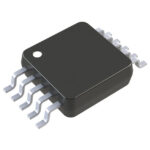 MAX5454EUB+

The activity of extra discounts on wholesale prices is in full swing…
Please fill in your contact information and we will send you the latest wholesale price list.





