 ChipApex | Global Electronic Components Supplier

SEARCH
Search Product
Search Post
— IC芯片 | 连接器 | 传感器 | 被动器件 —
Search productSearch post
— IC芯片 | 连接器 | 传感器 | 被动器件 —
Consult the customer manager about the wholesale price.
consultation hotline:86-132-6715-2157
email:[email protected]
Contact the product manager for consultation. One-stop consultation is available.
Do you want a lower wholesale price? Please send us your inquiry and we will reply immediately.
The MAX5477EUD+ is a dual, nonvolatile digital potentiometer featuring an I2C-compatible serial interface. It provides two independent potentiometers, each with 256 tap positions and a nominal end-to-end resistance of 10kΩ. The device operates from a single supply voltage ranging from +2.7V to +5.25V, with a maximum static supply current of 1µA. It includes internal nonvolatile EEPROM for wiper position recall upon power-up and supports fast-mode communication at data rates up to 400kbps. The component is housed in a 14-pin TSSOP package and functions over an extended temperature range of -40°C to +85°C.
Verify the specific suffix EUD+ indicates the 14-pin TSSOP package variant with lead-free/RoHS compliance. Confirm the 10kΩ resistance value corresponds to the MAX5477 designation within the family. Ensure the operating environment remains within the specified -40°C to +85°C temperature range and that the supply voltage does not exceed 5.25V.
Select this component when a dual-channel digital solution with nonvolatile memory retention is required. The 10kΩ resistance value distinguishes it from the 50kΩ (MAX5478) and 100kΩ (MAX5479) variants. The TSSOP-14 package is suitable for applications where board space is limited but a through-hole or larger surface-mount footprint is not feasible. Verify I2C bus compatibility with the host microcontroller.
The MAX5477EUD+ belongs to the MAX5477/MAX5478/MAX5479 family of dual, nonvolatile, linear-taper digital potentiometers. These devices replace mechanical potentiometers using a simple digital interface. The MAX5477 specifically offers a 10kΩ end-to-end resistance, while sibling models provide 50kΩ and 100kΩ options. All family members share identical pinouts and functional characteristics, differing primarily in resistance values.
Direct substitutes include MAX5478EUD+ (50kΩ) and MAX5479EUD+ (100kΩ) if resistance scaling is acceptable. Single-channel alternatives like the MAX5466 series may be considered if only one potentiometer is needed, though they lack nonvolatile memory.
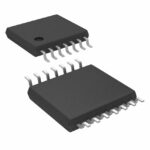 MAX5477EUD+

The activity of extra discounts on wholesale prices is in full swing…
Please fill in your contact information and we will send you the latest wholesale price list.





