 ChipApex | Global Electronic Components Supplier

SEARCH
Search Product
Search Post
— IC芯片 | 连接器 | 传感器 | 被动器件 —
Search productSearch post
— IC芯片 | 连接器 | 传感器 | 被动器件 —
Consult the customer manager about the wholesale price.
consultation hotline:86-132-6715-2157
email:[email protected]
Contact the product manager for consultation. One-stop consultation is available.
Do you want a lower wholesale price? Please send us your inquiry and we will reply immediately.
The MAX5479EUD+T is a dual, nonvolatile, linear-taper digital potentiometer IC from Analog Devices/Maxim Integrated. It features two independent potentiometers with 256 tap positions each and an end-to-end resistance of 100 kΩ. The device utilizes a fast-mode I²C-compatible serial interface for communication at data rates up to 400kbps. It operates on a single supply voltage ranging from +2.7V to +5.25V. Key electrical characteristics include a maximum static supply current of 1µA, ±1 LSB integral nonlinearity (INL), and ±0.5 LSB differential nonlinearity (DNL) in voltage-divider mode.
Verify the package type corresponds to the EUD suffix, which indicates a 14-pin TSSOP. Confirm RoHS compliance via the '+' designation in the part number. Ensure the specific resistance value matches the MAX5479 variant (100kΩ) rather than the MAX5477 (10kΩ) or MAX5478 (50kΩ). Check datasheet specifications for absolute maximum ratings regarding continuous current into terminals.
Select the MAX5479 when a 100kΩ end-to-end resistance is required. Choose this component over volatile digital potentiometers if power-on recall of the wiper position is necessary. Consider the 14-pin TSSOP package constraints for board space. Verify that the application supports the I²C protocol and can handle the address configuration via A0-A2 pins for multi-device bus sharing.
The MAX5479 is part of the MAX5477/MAX5478/MAX5479 family of dual, nonvolatile, I²C-interface digital potentiometers. While all three share identical pinouts, interfaces, and nonvolatile memory features, they differ primarily in their nominal end-to-end resistance values. The MAX5479 specifically provides 100kΩ resistance, distinguishing it from the 10kΩ MAX5477 and 50kΩ MAX5478.
Direct functional replacements within the same family include the MAX5477EUD+T (10kΩ) and MAX5478EUD+T (50kΩ), provided the resistance tolerance aligns with circuit requirements. Other nonvolatile dual digital potentiometers with I²C interfaces may serve as alternatives but require verification of pin compatibility and electrical parameters.
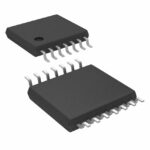 MAX5479EUD+T

The activity of extra discounts on wholesale prices is in full swing…
Please fill in your contact information and we will send you the latest wholesale price list.





