 ChipApex | Global Electronic Components Supplier

SEARCH
Search Product
Search Post
— IC芯片 | 连接器 | 传感器 | 被动器件 —
Search productSearch post
— IC芯片 | 连接器 | 传感器 | 被动器件 —
Consult the customer manager about the wholesale price.
consultation hotline:86-132-6715-2157
email:[email protected]
Contact the product manager for consultation. One-stop consultation is available.
Do you want a lower wholesale price? Please send us your inquiry and we will reply immediately.
The MAX5527GUA+T is a one-time programmable, linear-taper digital potentiometer manufactured by Analog Devices (Maxim Integrated). It provides an end-to-end resistance of 100kΩ with 64 wiper tap positions. The device operates on a single +2.7V to +5.5V supply and features a simple 2-wire up/down interface for sequential adjustment. Key electrical parameters include a 35ppm/°C end-to-end temperature coefficient and a maximum static supply current of 1.5µA. It is housed in an 8-pin µMAX package and is guaranteed to operate within the -40°C to +105°C temperature range.
Verify component authenticity through authorized distributors or direct manufacturer channels. Confirm RoHS compliance status as indicated by the '+' suffix in the part number. Ensure proper handling procedures are followed during storage and assembly to maintain device reliability.
Select this model when a 100kΩ total resistance is required. Compare against MAX5528 (50kΩ) and MAX5529 (10kΩ) if different resistance values are needed. Verify that the 8-pin µMAX package dimensions fit the PCB layout constraints compared to the TDFN alternative.
This component belongs to the MAX5527/MAX5528/MAX5529 family of linear-taper digital potentiometers. These devices function as mechanical potentiometer replacements, offering digital control over resistance values without moving parts. The GUA+T designation specifically identifies the 100kΩ variant in the 8-pin µMAX lead-free package.
Direct functional substitutes within the same series include MAX5528GUA+T (50kΩ) and MAX5529GUA+T (10kΩ). For identical specifications but different packaging, consider MAX5527GTA+T which utilizes an 8-pin TDFN-EP package instead of µMAX.
The wiper position is locked by performing a seven-pulse CS high sequence during the one-time programming mode. This disables the up/down interface, preventing further adjustments.
The external voltage source connected to the PV pin must be in the range of +11V to +11.55V to successfully program the one-time memory.
Since the device uses one-time programmable memory, applying multiple programming values results in all applied bits being ORed together, potentially altering the intended resistance profile.
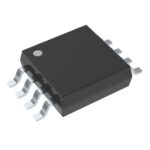 MAX5527GUA+T

The activity of extra discounts on wholesale prices is in full swing…
Please fill in your contact information and we will send you the latest wholesale price list.





