 ChipApex | Global Electronic Components Supplier
SEARCH
Search Product
Search Post
— IC芯片 | 连接器 | 传感器 | 被动器件 —
Search productSearch post
— IC芯片 | 连接器 | 传感器 | 被动器件 —
Consult the customer manager about the wholesale price.
consultation hotline:86-132-6715-2157
email:[email protected]
Contact the product manager for consultation. One-stop consultation is available.
Do you want a lower wholesale price? Please send us your inquiry and we will reply immediately.
The MAX7405EPA+ is an 8th-order, lowpass, Bessel switched-capacitor filter operating from a single +3V supply. It draws 2mA in normal mode and 0.2µA in shutdown. The corner frequency ranges from 1Hz to 5kHz via a 100:1 clock-to-corner ratio using internal or external clocks. Key parameters include ±5mV output offset, -84dB THD+N, and 60dB PSRR. It features a low-pass Bessel response for fast settling and minimal overshoot.
Verify the package type matches the required footprint, as the 'E' suffix indicates an industrial temperature range (-40°C to +85°C) while 'C' denotes commercial range. Confirm the '+' suffix ensures lead-free compliance. Cross-reference the specific ordering code against official manufacturer documentation to ensure correct voltage and temperature specifications.
Select this component when a single +3V supply is available and low power consumption is critical. The fixed Bessel response simplifies design by eliminating complex pole-zero calculations. Ensure the application requires a maximum corner frequency of 5kHz and can accommodate the necessary clock frequency requirements relative to the desired cutoff.
This device belongs to the MAX7401/MAX7405 family of switched-capacitor filters. The MAX7405 variant is specifically designed for +3V operation, whereas the MAX7401 supports +5V supplies. Both share identical electrical characteristics regarding filter order, response type, and pinout configurations within the 8-pin SOIC and PDIP packages.
The MAX7401 serves as a direct functional substitute if the system operates on a +5V supply instead of +3V. Other members of the MAX740x series may offer different filter responses but require verification of pin compatibility and electrical parameter alignment.
The corner frequency is set by the clock frequency divided by 100. It can be controlled via an external clock source or an internal oscillator defined by a capacitor connected between the CLK and GND pins.
The Offset Adjust (OS) pin allows for adjustment of the DC output level. Connecting it to the COM pin sets the default bias, while applying an external voltage enables DC level shifting.
Driving the SHDN pin low activates shutdown mode, reducing supply current to 0.2µA and placing the output in a high-impedance state. Driving it high restores normal operation.
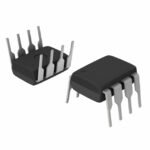 MAX7405EPA+
The activity of extra discounts on wholesale prices is in full swing…
Please fill in your contact information and we will send you the latest wholesale price list.





