 ChipApex | Global Electronic Components Supplier
SEARCH
Search Product
Search Post
— IC芯片 | 连接器 | 传感器 | 被动器件 —
Search productSearch post
— IC芯片 | 连接器 | 传感器 | 被动器件 —
Consult the customer manager about the wholesale price.
consultation hotline:86-132-6715-2157
email:[email protected]
Contact the product manager for consultation. One-stop consultation is available.
Do you want a lower wholesale price? Please send us your inquiry and we will reply immediately.
The MAX7418EUA+ is a fifth-order, low-pass switched-capacitor filter with an elliptic response and a transition ratio of 1.6. It operates from a single +5V supply (4.5V to 5.5V) and draws 3mA in active mode, reducing to 0.2μA in shutdown. The corner frequency is clock-tunable from 1Hz to 30kHz using a 100:1 clock-to-corner ratio. Key electrical parameters include a typical output offset voltage of ±4mV, a power-supply rejection ratio of 70dB, and a maximum capacitive load drive of 500pF. It features an offset adjust pin and is housed in an 8-pin μMAX package.
Verify the component matches the specific elliptic response variant required for the design. Confirm the operating voltage aligns with the +5V specification for this model. Ensure the industrial temperature range (-40°C to +85°C) meets system requirements. Check for RoHS compliance status indicated by the suffix.
Select this part when a steep roll-off is needed compared to Bessel or Butterworth variants. Ensure the clock source can provide frequencies up to 3MHz for the full tuning range. Verify that the input signal amplitude stays within limits to maintain low distortion. Consider the 100:1 clock-to-corner ratio when designing the clock generation circuitry.
This device belongs to the MAX7418–MAX7425 family of fifth-order low-pass switched-capacitor filters. The 'E' suffix denotes the extended industrial temperature range of -40°C to +85°C. The '+EA' indicates an 8-pin μMAX package with lead-free and RoHS-compliant materials.
Public confirmed substitute part numbers are not available in the provided documentation.
The corner frequency is set by the clock frequency divided by 100. It can be controlled via an external capacitor on the CLK pin for the internal oscillator or by an external clock signal.
The OS (Offset Adjust) pin allows for adjustment of the DC output level. It should be connected to COM if no offset adjustment is needed.
Driving the SHDN pin low activates shutdown mode, reducing supply current to 0.2μA and placing the output in a high-impedance state.
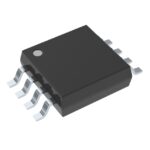 MAX7418EUA+
The activity of extra discounts on wholesale prices is in full swing…
Please fill in your contact information and we will send you the latest wholesale price list.





