 ChipApex | Global Electronic Components Supplier
SEARCH
Search Product
Search Post
— IC芯片 | 连接器 | 传感器 | 被动器件 —
Search productSearch post
— IC芯片 | 连接器 | 传感器 | 被动器件 —
Consult the customer manager about the wholesale price.
consultation hotline:86-132-6715-2157
email:[email protected]
Contact the product manager for consultation. One-stop consultation is available.
Do you want a lower wholesale price? Please send us your inquiry and we will reply immediately.
The MAX7424EUA+T is a fifth-order, low-pass switched-capacitor filter (SCF) from the MAX7418–MAX7425 series. It provides a Butterworth response with a maximally flat passband and operates on a single +3V supply. The device draws 3mA in operating mode and features a shutdown current of 0.2μA. Corner frequencies are programmable from 1Hz to 45kHz using a 100:1 clock-to-corner ratio. Key electrical parameters include a typical output offset voltage of ±4mV, a power-supply rejection ratio (PSRR) of 70dB, and an insertion gain of -0.2dB at the corner frequency.
Verify the component authenticity by checking the manufacturer's marking and datasheet revision against official Analog Devices documentation. Confirm that the ordering suffix matches the specified temperature range and package type. Ensure compliance with relevant environmental standards as indicated in the product documentation before integration into production designs.
Select the MAX7424EUA+T when a maximally flat passband response is required for instrumentation or data conversion interfaces. This part is optimized for single +3V supplies, distinguishing it from the +5V variants in the family. Designers must account for the 100:1 clock-to-corner frequency ratio when selecting external clock sources or timing capacitors to achieve the desired cutoff characteristics.
This component belongs to the MAX7418–MAX7425 family of fifth-order low-pass switched-capacitor filters. While other members offer elliptic or Bessel responses, the MAX7424 specifically delivers Butterworth characteristics. The 'E' suffix denotes an extended industrial temperature range of -40°C to +85°C, and the '+T' indicates tape-and-reel packaging for automated assembly processes.
Direct functional replacements within the same family include the MAX7420CUA for commercial temperature ranges. For different filter responses, consider the MAX7419/MAX7423 for Bessel characteristics or the MAX7418/MAX7422 for elliptic rolloff. Verify pinout compatibility and supply voltage requirements when substituting.
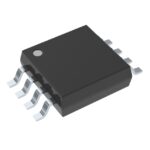 MAX7424EUA+T
The activity of extra discounts on wholesale prices is in full swing…
Please fill in your contact information and we will send you the latest wholesale price list.





