 ChipApex | Global Electronic Components Supplier
SEARCH
Search Product
Search Post
— IC芯片 | 连接器 | 传感器 | 被动器件 —
Search productSearch post
— IC芯片 | 连接器 | 传感器 | 被动器件 —
Consult the customer manager about the wholesale price.
consultation hotline:86-132-6715-2157
email:[email protected]
Contact the product manager for consultation. One-stop consultation is available.
Do you want a lower wholesale price? Please send us your inquiry and we will reply immediately.
The MAX7425EUA+ is a fifth-order, low-pass switched-capacitor filter (SCF) from the MAX7418–MAX7425 series. It operates on a single +3V supply and draws 3mA of current in active mode, reducing to 0.2μA in shutdown. The device provides an elliptic response with a sharp rolloff transition ratio of 1.25 and typical stopband rejection of 37dB. Corner frequencies are programmable from 1Hz to 45kHz via a 100:1 clock-to-corner frequency ratio. It features a low output offset voltage of ±4mV and supports both internal oscillator and external clocking options.
Verify the component authenticity by checking the manufacturer's marking and package integrity against official datasheet specifications. Confirm the operating temperature range matches the 'E' suffix designation (-40°C to +85°C). Ensure the supply voltage requirements align with the specific +3V operation limits defined for the MAX7425 variant before integration into the design.
Select the MAX7425 when a sharp cutoff characteristic is required alongside low power consumption. This model is specifically optimized for +3V single-supply systems. Designers must ensure the application requires the elliptic response profile rather than the Bessel or Butterworth alternatives available within the same family. Verify that the clock source can support the necessary frequency division ratio for the desired corner frequency.
The MAX7425 belongs to the MAX7418–MAX7425 family of fifth-order, low-pass switched-capacitor filters manufactured by Analog Devices Inc./Maxim Integrated. These devices utilize a switched-capacitor integrator approach to emulate passive ladder networks, offering low component sensitivity compared to traditional biquadratic designs. The family covers various filter responses including elliptic, Bessel, and Butterworth types.
The MAX7422 serves as a direct functional substitute within the same family, sharing the identical elliptic response and physical package but operating at a +5V supply voltage instead of +3V. Designers must account for the difference in supply voltage requirements when considering this alternative.
The corner frequency is determined by the clock frequency applied to the CLK pin, following a fixed 100:1 ratio where fC = fCLK / 100. This allows for precise tuning between 1Hz and 45kHz.
The OS (Offset Adjust) pin allows for adjustment of the DC output level. It can be connected to COM if no offset adjustment is needed, or driven by an external bias voltage to shift the DC output level relative to the common-mode input.
Yes, while designed for single-supply operation, the device can be used in dual-supply configurations by connecting COM to system ground and GND to the negative supply, maintaining equivalent performance characteristics.
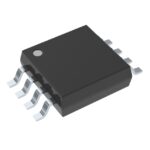 MAX7425EUA+
The activity of extra discounts on wholesale prices is in full swing…
Please fill in your contact information and we will send you the latest wholesale price list.





