 ChipApex | Global Electronic Components Supplier
SEARCH
Search Product
Search Post
— IC芯片 | 连接器 | 传感器 | 被动器件 —
Search productSearch post
— IC芯片 | 连接器 | 传感器 | 被动器件 —
Consult the customer manager about the wholesale price.
consultation hotline:86-132-6715-2157
email:[email protected]
Contact the product manager for consultation. One-stop consultation is available.
Do you want a lower wholesale price? Please send us your inquiry and we will reply immediately.
The MAX7448EUD+ is a 4-channel buffered video reconstruction filter designed for anti-aliasing and DAC smoothing in analog video systems. It operates from a single +5V supply, providing a flat passband out to 5MHz with a stopband attenuation of 43dB at 27MHz. The device processes RGB and asynchronous CVBS signals, featuring a fixed gain of +6dB on each output buffer. Channel D includes high-frequency boost circuitry (+1.2dB) to enhance picture sharpness without degrading the stopband. Each output can drive two standard 150Ω video loads, making it suitable for NTSC, PAL, and SDTV applications.
Verify the specific ordering suffix against official manufacturer documentation to confirm package type and temperature range. Confirm RoHS compliance status through current datasheets or component markings. Check for availability of evaluation kits if hardware validation is required during the design phase.
Select this component when designing systems requiring simultaneous filtering of RGB and composite video signals from a single power rail. Ensure the application utilizes a +5V supply and requires outputs capable of driving dual 150Ω loads. Verify that the 5MHz bandwidth aligns with the target video standard specifications.
This part belongs to the MAX7448 series of video filters manufactured by Analog Devices / Maxim Integrated. It is housed in a 14-pin TSSOP package with an exposed pad for thermal management. The device is specified for operation across an extended temperature range of -40°C to +85°C.
Consult official manufacturer substitution guides for verified alternatives. Do not assume functional equivalence with other video filters without verifying pinout compatibility and electrical parameter alignment.
The device uses internal DC restore loops activated by sync pulses. Channels A, B, and C are clamped based on the sync pulse detected on Channel A, while Channel D uses its own local sync separator for independent clamping.
Channel D provides +1.2dB of high-frequency boost to compensate for signal degradation and rolloff inherent in video encoders, thereby improving picture sharpness without affecting the stopband attenuation.
Yes, the output buffers support both configurations. They can drive DC loads directly with an output blanking level below 1V, or drive AC-coupled loads using external capacitors as small as 220µF.
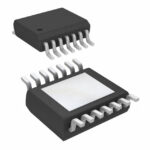 MAX7448EUD+
The activity of extra discounts on wholesale prices is in full swing…
Please fill in your contact information and we will send you the latest wholesale price list.






