 ChipApex | Global Electronic Components Supplier
SEARCH
Search Product
Search Post
— IC芯片 | 连接器 | 传感器 | 被动器件 —
Search productSearch post
— IC芯片 | 连接器 | 传感器 | 被动器件 —
Consult the customer manager about the wholesale price.
consultation hotline:86-132-6715-2157
email:[email protected]
Contact the product manager for consultation. One-stop consultation is available.
Do you want a lower wholesale price? Please send us your inquiry and we will reply immediately.
The MAX7490CEE+T is a dual universal switched-capacitor filter housed in a 16-pin QSOP package. It operates from a single +5V supply within a voltage range of 4.5V to 5.5V and supports an operating temperature range of 0°C to +70°C. The device features two identical second-order filter sections capable of generating bandpass, lowpass, highpass, and notch functions simultaneously. It supports a center frequency up to 40kHz with a fixed clock-to-center frequency ratio of 100:1. Key electrical parameters include a Q accuracy of ±0.2%, a power-supply current of 3.5mA to 4.0mA, and a shutdown current of less than 1µA.
Verify the specific ordering suffix CEE against official documentation to confirm the commercial temperature range and lead-free status. Ensure the design accommodates the 16-pin QSOP physical dimensions and thermal requirements. Confirm that the single +5V supply requirement aligns with the system power architecture before finalizing procurement.
Select this component when dual independent filter channels are required within a compact footprint. The fixed 100:1 clock-to-frequency ratio simplifies design calculations compared to variable-ratio alternatives. Consider the internal rail splitter for simplified single-supply biasing. Evaluate the need for external op-amps if higher-order elliptic or Cauer responses are necessary using Modes 2N or 3A.
This part belongs to the MAX7490/MAX7491 family of dual universal switched-capacitor filters. The MAX7490 variant is specifically designed for +5V operation, whereas the MAX7491 supports +3V supplies. Both share identical pinouts and functional capabilities but differ in supply voltage specifications and internal common-mode impedance characteristics.
The MAX7490EEE+ serves as a direct replacement offering the same functionality with an extended industrial temperature range of -40°C to +85°C. Verify that the application environment remains within the 0°C to +70°C range for the CEE variant or upgrade to the EEE variant if wider thermal tolerance is required.
The center frequency is determined by the clock frequency divided by 100. This can be achieved using an external clock source or an internal oscillator set by an external capacitor connected to the CLK pin.
The SHDN pin controls the low-power shutdown mode. Driving it low reduces the supply current to less than 1µA and places the outputs in a high-impedance state. Driving it high enables normal operation.
Yes, fourth-order filters can be obtained by cascading the two second-order filter sections contained within the single MAX7490 package.
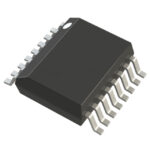 MAX7490CEE+T
The activity of extra discounts on wholesale prices is in full swing…
Please fill in your contact information and we will send you the latest wholesale price list.






