 ChipApex | Global Electronic Components Supplier
SEARCH
Search Product
Search Post
— IC芯片 | 连接器 | 传感器 | 被动器件 —
Search productSearch post
— IC芯片 | 连接器 | 传感器 | 被动器件 —
Consult the customer manager about the wholesale price.
consultation hotline:86-132-6715-2157
email:[email protected]
Contact the product manager for consultation. One-stop consultation is available.
Do you want a lower wholesale price? Please send us your inquiry and we will reply immediately.
The MAX7491CEE+ is a dual universal switched-capacitor filter from Analog Devices/Maxim Integrated, housed in a 16-pin QSOP package. It operates on a single +3V supply with a voltage range of 2.7V to 3.6V and supports an operating temperature range of 0°C to +70°C. The device features two identical 2nd-order filter sections capable of generating bandpass, lowpass, highpass, and notch functions simultaneously. It achieves a center frequency up to 40kHz with a clock-to-center frequency ratio of 100:1 and offers Q accuracy within ±0.2%.
Verify the specific suffix CEE+ against official documentation to confirm the commercial temperature range (0°C to +70°C) and lead-free/RoHS compliance status. Ensure the single +3V supply requirement aligns with system power constraints. Cross-reference the 16-pin QSOP package dimensions with PCB layout guidelines to guarantee mechanical fit and thermal performance during integration.
Select the MAX7491 over the MAX7490 when the application requires a single +3V supply instead of +5V. Verify that the required center frequency falls within the 40kHz maximum limit. Consider cascading multiple units if higher-order filtering than the built-in dual 2nd-order sections is necessary. Confirm that the external resistor values used for setting Q and gain are compatible with the device's input impedance characteristics.
The MAX7491 belongs to the MAX749x family of dual universal switched-capacitor filters manufactured by Maxim Integrated, now part of Analog Devices. This series provides versatile analog filtering solutions in a small footprint. The MAX7491 specifically targets low-voltage applications requiring precise frequency response without the need for large external passive components typically found in RC active filters.
MAX7490CEE+ (identical functionality with +5V supply)
The center frequency is determined by the clock frequency applied to the CLK pin, maintaining a fixed 100:1 ratio (fO = fCLK / 100).
Yes, by connecting the COM pin to system ground and the GND pin to the negative supply, allowing use with ±1.5V rails.
Driving the SHDN pin low activates a low-power shutdown mode, reducing supply current to less than 1µA and placing outputs in a high-impedance state.
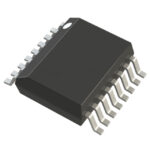 MAX7491CEE+
The activity of extra discounts on wholesale prices is in full swing…
Please fill in your contact information and we will send you the latest wholesale price list.





