 ChipApex | Global Electronic Components Supplier
SEARCH
Search Product
Search Post
— IC芯片 | 连接器 | 传感器 | 被动器件 —
Search productSearch post
— IC芯片 | 连接器 | 传感器 | 被动器件 —
Consult the customer manager about the wholesale price.
consultation hotline:86-132-6715-2157
email:[email protected]
Contact the product manager for consultation. One-stop consultation is available.
Do you want a lower wholesale price? Please send us your inquiry and we will reply immediately.
The MAX9005EUA+T is a low-power, high-speed single-supply operational amplifier integrated with a comparator. It operates from a +2.5V to +5.5V supply and draws 340µA of quiescent current. The op amp features an 8MHz gain-bandwidth product and is stable for closed-loop gains of +10V/V or greater. Both the amplifier and comparator outputs swing rail-to-rail. The device includes ground-sensing inputs and eliminates phase reversal for overdriven inputs.
Verify the specific ordering suffix against official manufacturer documentation to confirm package type and temperature range. Ensure compatibility with existing board layouts by checking pin configurations. Confirm availability status through authorized distribution channels as stock levels fluctuate.
Select this component when a combined amplification and comparison function is required in a compact footprint. It is suitable for applications needing rail-to-rail output swing on a single supply. Consider the decompensated nature (stable at gains >= 10V/V) for higher bandwidth requirements compared to unity-gain stable variants.
This part belongs to the MAX9000 family of mixed-signal ICs designed for portable and battery-powered applications. The family integrates precision references, comparators, and operational amplifiers to reduce system component count. The MAX9005 specifically omits the internal reference found in other family members to save power and cost.
Consult official manufacturer substitution guides for confirmed equivalent parts. Verify that any replacement maintains the same 8-pin µMAX package dimensions and electrical characteristics. Ensure functional compatibility regarding gain stability and output drive capabilities before implementation.
No, the MAX9005 op amp is decompensated and is stable only for closed-loop gains of +10V/V or greater.
No, the MAX9005 does not contain an internal precision reference; this feature is available in the MAX9000, MAX9001, MAX9003, and MAX9004 variants.
The comparator has a typical propagation delay of 185ns.
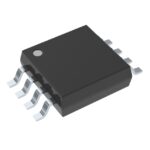 MAX9005EUA+T
The activity of extra discounts on wholesale prices is in full swing…
Please fill in your contact information and we will send you the latest wholesale price list.





