 ChipApex | Global Electronic Components Supplier

SEARCH
Search Product
Search Post
— IC芯片 | 连接器 | 传感器 | 被动器件 —
Search productSearch post
— IC芯片 | 连接器 | 传感器 | 被动器件 —
Consult the customer manager about the wholesale price.
consultation hotline:86-132-6715-2157
email:[email protected]
Contact the product manager for consultation. One-stop consultation is available.
Do you want a lower wholesale price? Please send us your inquiry and we will reply immediately.
MAX9208EAI+ is listed in the Serializers, Deserializers range at ChipApex. The manufacturer field lists Analog Devices Inc./Maxim Integrated. Its product description is IC DESERIALIZER LVDS 28-SSOP. Review the specifications below when checking this part for your BOM.
The MAX9208EAI+ is a 10-bit bus LVDS deserializer manufactured by Analog Devices Inc./Maxim Integrated. It transforms high-speed serial BLVDS data streams into 10-bit-wide parallel LVCMOS/LVTTL data and clock signals. The device operates with a reference clock range of 40MHz to 66MHz, supporting throughput up to 600Mbps. It functions within a supply voltage range of +3.0V to +3.6V and is specified for temperatures from -40°C to +85°C. The component is housed in a 28-pin SSOP package.
Verify the specific ordering suffix EAI+ against official manufacturer documentation to confirm lead-free/RoHS compliance status. Confirm that the 28-SSOP package variant matches the required footprint for the design. Ensure the reference clock frequency requirements align with the 40MHz to 66MHz specification range before finalizing procurement.
Select the MAX9208EAI+ when data rates between 400Mbps and 600Mbps are required, as it supports higher frequencies than the MAX9206. Ensure the system reference clock falls within the 40MHz to 66MHz range. Verify compatibility with paired serializers like the MAX9205 or MAX9207 for complete SerDes functionality.
The MAX9208EAI+ belongs to the MAX9206/MAX9208 family of 10-bit bus LVDS deserializers. It pairs with serializers such as the MAX9205 and MAX9207 to reduce interconnect complexity and board size. This family eliminates parallel bus skew by serializing data over BLVDS links.
The MAX9206EAI+ is a pin-compatible alternative but supports lower data rates (up to 450Mbps) and a different reference clock range (16MHz to 45MHz). Verify if the application requires the higher throughput capabilities unique to the MAX9208.
The device uses a deductive algorithm to eliminate rising edges caused by data until the embedded end/start edge is found, allowing initialization without disrupting other links.
The LOCK pin goes low when the PLL achieves frequency and phase lock to the serial input and framing bits are identified, indicating valid data at the outputs.
Yes, driving the REN (Output Enable) pin low puts ROUT_ and RCLK into a high-impedance state without losing lock to the serial input.
Explore related parts through Interface, Integrated Circuits (ICs), all product categories, ChipApex homepage.
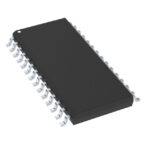 MAX9208EAI+

The activity of extra discounts on wholesale prices is in full swing…
Please fill in your contact information and we will send you the latest wholesale price list.





