 ChipApex | Global Electronic Components Supplier
SEARCH
Search Product
Search Post
— IC芯片 | 连接器 | 传感器 | 被动器件 —
Search productSearch post
— IC芯片 | 连接器 | 传感器 | 被动器件 —
Consult the customer manager about the wholesale price.
consultation hotline:86-132-6715-2157
email:[email protected]
Contact the product manager for consultation. One-stop consultation is available.
Do you want a lower wholesale price? Please send us your inquiry and we will reply immediately.
The MAX96717GTJ/VY+ is a GMSL serializer that receives video on an MIPI CSI-2 interface and outputs it on a GMSL2 serial link transceiver. It operates at fixed forward rates of 3Gbps or 6Gbps, with a reverse rate of 187.5Mbps. The device supports four-lane MIPI CSI-2 v1.3 input with D-PHY v1.2 receivers rated at 2.5Gbps per lane. It features two I2C/UART pass-through channels, flexible GPIO, SPI tunneling, a built-in ADC, and temperature sensor. Qualified to AEC-Q100 Grade 2 standards, it functions within an automotive temperature range of -40°C to +105°C.
Verify the specific ordering suffix against official documentation to confirm package type and temperature grade. Confirm RoHS compliance status through manufacturer datasheets before procurement. Ensure compatibility with matching deserializers for system integration. Validate supply chain sources directly with authorized distributors to avoid counterfeit components.
Select this serializer when interfacing MIPI CSI-2 image sensors with GMSL2 deserializers in automotive environments. Consider the required forward data rate and cable attenuation characteristics for optimal performance. Evaluate the need for ASIL-B functional safety features and tunneling mode capabilities. Verify power supply requirements and thermal management needs for the target application.
The MAX96717 belongs to the Maxim Integrated GMSL family of serializers designed for automotive vision systems. It complements deserializers like the MAX96724 to form complete video transmission links. The component enables high-bandwidth, low-latency video transfer over coaxial or shielded twisted pair cables in vehicle architectures.
MAX96717KATJ/VY+
The device operates at fixed forward rates of 3Gbps or 6Gbps, and a reverse rate of 187.5Mbps.
It is ASIL-B compliant, featuring end-to-end data integrity through CRC in tunneling mode, R-S forward-error correction, and power-on self-test.
Data can be transmitted over 50Ω Coax or 100Ω Shielded-Twisted Pair (STP) cables that meet the GMSL2 channel specification.
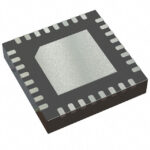 MAX96717GTJ/VY+
The activity of extra discounts on wholesale prices is in full swing…
Please fill in your contact information and we will send you the latest wholesale price list.





